AI estimate as of December 15, 2025 · verify with a professional before acting
AI-Generated · Verify before acting
Everything on this page is generated by AI for informational purposes only. AI can make mistakes — the AI may misidentify items or misattribute them (artist, maker, brand, designer, origin, era). This is not an official valuation and should not be used for insurance, sale, tax, estate, legal, or lending purposes — or any decision requiring a certified appraisal. It is not an authoritative claim about any person, brand, or rights holder — do not share or rely on it as a factual statement about a third party. Always consult qualified professionals before making financial decisions.
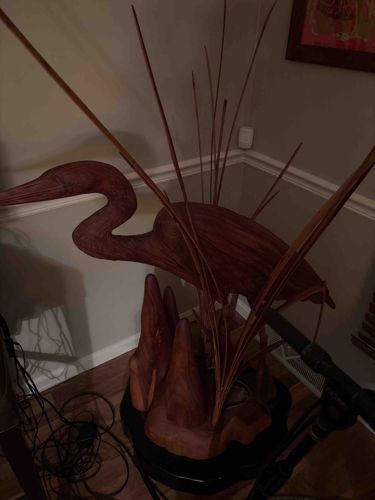
This appears to be a large, free-standing sculpture depicting a heron or similar wading bird, crafted predominantly from rich, reddish-brown wood. The overall composition suggests a bird in a naturalistic setting, with a long, elegant neck curving gracefully downwards, forming a substantial body that tapers to a tail. The texture of the wood appears to be finely carved, potentially exhibiting visible wood grain throughout, adding to its organic appeal. Attached to the body of the bird and emanating from the base are several thin, long, reedy elements, likely also made of wood or a natural material, designed to simulate tall marsh grasses or reeds, enhancing the natural habitat theme. The base itself is a substantial, dark, possibly ebonized or stained wood, providing stability and contrast. The bird's legs are not distinctly visible, suggesting it is either integrated into the 'marsh' base or supported by unseen means. The carving technique seems to be solid throughout the bird's body, indicating skilled craftsmanship. No obvious damage or significant wear is discernible from the image, suggesting it has been well-preserved. There are no visible maker's marks or signatures, preventing immediate identification of the artist or origin. The style suggests it could be a contemporary decorative piece or perhaps from the mid-20th century 'tropical' or 'primitive' art influences, though a precise age is difficult to determine without further information. The size appears substantial, suitable for floor display. The quality of the carving, particularly the smooth curves and the integration of the 'reeds,' points to a well-executed decorative art piece designed to evoke a serene, natural environment.
AI Appraisal Report
Based on my visual examination of the provided image, this Carved Wood Heron Sculpture presents as a well-crafted decorative art piece. The condition appears excellent with no discernible damage, chips, or significant wear, suggesting careful preservation. The carving quality is notable, particularly the smooth, elegant curves of the bird's neck and body, and the integration of the reedy elements, which enhance its naturalistic appeal. The reddish-brown wood and dark, stable base contribute to a visually appealing, substantial object suitable for floor display.
From a market perspective, comparable carved wood animal sculptures, especially those of good size and craftsmanship, indicate a steady demand. Pieces evoking natural themes, like this heron in reeds, tend to be popular for their decorative versatility. While not a unique or rare item in terms of subject matter, the quality of execution and apparent solid wood construction elevate it above mass-produced items. The lack of maker's marks or signatures, however, prevents attribution to a known artist or workshop, which significantly impacts its potential for higher value as fine art. It most likely falls into the category of well-made decorative arts, possibly mid-20th century to contemporary, influenced by naturalistic and some 'tropical' design aesthetics.
Factors impacting value include its appealing aesthetic, good condition, and substantial size. The primary limitation in authenticity verification from an image alone is the inability to determine the type of wood, precise age, or identify potential restorations. An in-person examination would allow for tactile assessment of the carve quality, identification of wood species, assessment of joinery, and closer inspection for hidden marks or repairs. Further provenance documentation would be crucial to establish any artistic attribution or specific origin, which could significantly increase its value.