AI estimate as of September 26, 2025 · verify with a professional before acting
AI-Generated · Verify before acting
Everything on this page is generated by AI for informational purposes only. AI can make mistakes — the AI may misidentify items or misattribute them (artist, maker, brand, designer, origin, era). This is not an official valuation and should not be used for insurance, sale, tax, estate, legal, or lending purposes — or any decision requiring a certified appraisal. It is not an authoritative claim about any person, brand, or rights holder — do not share or rely on it as a factual statement about a third party. Always consult qualified professionals before making financial decisions.
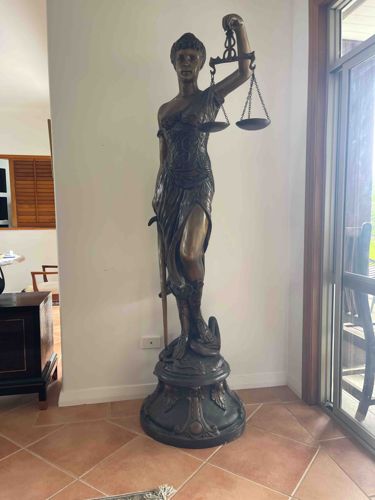
This is a large, freestanding statue depicting Lady Justice, an allegorical personification of the moral force in judicial systems. The statue appears to be crafted from bronze, exhibiting a rich, dark patinated finish that lends it an aged and classic appearance. The figure stands tall, holding a set of scales (symbolizing fairness and balance) aloft in her left hand and a sword (representing the power of reason and justice) in her right hand, which rests against her side. Notably, the figure is *not* blindfolded, which is often a common depiction of Lady Justice, symbolizing impartiality. She is draped in flowing robes, with intricate folds and textures visible, particularly around her waist and legs, suggesting a classical or neoclassical artistic influence. The base of the statue is substantial and elaborately decorated with what appears to be acanthus leaves or similar ornate floral motifs, adding to its grand presentation and stability. The overall craftsmanship suggests a well-executed cast piece, with attention to detail in the drapery and facial features, although the resolution of the image does not permit a very close examination of the latter. The scale of the statue, indicated by its presence in a domestic setting next to a window and typical interior furniture, suggests it is a significant, possibly life-size or near life-size, piece. There are no immediately obvious significant condition issues like severe damage or repairs visible, though minor wear consistent with its age and material (such as subtle variations in patination or superficial scratches) might be present upon closer inspection. The style points towards a traditional or academic artistic period, likely late 19th or 20th century.
AI Appraisal Report
Upon examining the provided image, I assess this large bronze Lady Justice statue. Its substantial size, indicated by its setting, suggests it is a significant feature piece. The dark, rich patination is consistent with a well-maintained bronze, giving it an aged, classical aesthetic. The craftsmanship evident in the flowing robes, intricate base with acanthus leaf motifs, and overall casting quality points to a traditional or academic artistic period, likely late 19th to mid-20th century. The absence of a blindfold is a notable design choice, distinguishing it from many common depictions.
Condition appears very good; I observe no obvious damage, repairs, or significant wear from the image. However, a more thorough, in-person examination would be necessary to identify subtle surface scratches, variations in patination, or hairline cracks that might not be visible here. Authenticity as a genuine bronze casting of significant age seems plausible, but without physical inspection, I cannot verify its material composition conclusively (e.g., distinguishing it from a high-quality resin composite with a bronze finish). Provenance documentation would be crucial to confirm its origin, artist, and specific casting details.
The market for large, decorative bronzes, especially allegorical figures like Lady Justice, remains relatively strong, driven by demand for estate décor, institutional settings, and architectural accents. Comparables for well-executed bronze statues of this scale and subject matter often range significantly based on artist, foundry, and documented history. Rarity is moderate; while Lady Justice is a common theme, a large, well-cast piece in good condition offers appeal. Factors impacting value positively include its impressive scale, apparent good condition, and detailed artistry. The primary limitation in value assessment here is the inability to conduct a physical inspection.
To fully authenticate and confirm value, I would need to perform an in-person examination to verify material, assess surface quality, check for foundry marks, and conduct scientific testing if required. Provenance documents—such as bills of sale, exhibition records, or artist documentation—would also be essential.