These notes were written by the person who submitted this item. Appraiser.AI has not verified them, and the AI's identification and estimate may rely on them.
AI Estimated Value
Not an official valuation
$15-25
AI estimate as of October 7, 2025 · verify with a professional before acting
AI-Generated · Verify before acting
Everything on this page is generated by AI for informational purposes only. AI can make mistakes — the AI may misidentify items or misattribute them (artist, maker, brand, designer, origin, era). This is not an official valuation and should not be used for insurance, sale, tax, estate, legal, or lending purposes — or any decision requiring a certified appraisal. It is not an authoritative claim about any person, brand, or rights holder — do not share or rely on it as a factual statement about a third party. Always consult qualified professionals before making financial decisions.
This analysis also relies on unverified notes provided by the user, which may be incomplete or inaccurate and could affect the result.
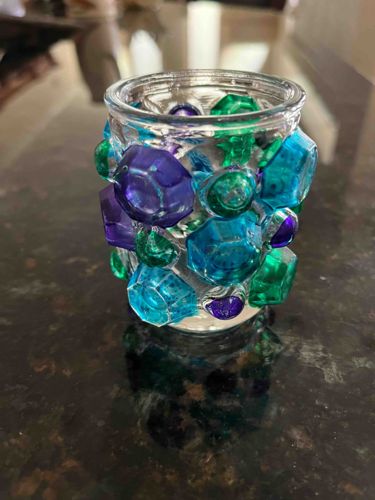
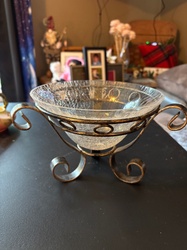
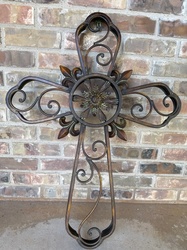
This item is a small, clear glass votive or candle holder, circular in shape, with a slightly flared rim. Its primary decorative feature consists of numerous faceted glass or acrylic jewels, adhered to the exterior surface of the glass container. The jewels are in varying shades of blue, green, and purple, arranged in an irregular, mosaic-like pattern that covers the majority of the holder's body. There are two distinct shapes of jewels visible: larger, somewhat hexagonal or octagonal facets, and smaller, rounder, cabochon-like pieces. The larger facets are predominantly turquoise (light blue-green), emerald green, and a deep violet-purple, exhibiting a translucent quality that allows light to pass through. The smaller, rounder pieces appear to be in similar colorways, filling in gaps between the larger jewels. The overall construction suggests a craft or DIY project, as the adhesive used to attach the jewels is visible in some areas, particularly where the jewels meet the clear glass. The underlying glass container appears to be a repurposed jar or a basic votive glass. No specific maker's marks or signatures are discernible from the image. The condition appears good, with no obvious signs of chips or cracks in the glass or the attached jewels. The reflective surface of the jewels creates a shimmering effect, designed to enhance the glow of a candle placed inside. The estimated age is relatively modern, likely a contemporary craft piece rather than an antique. Its unique aspect lies in the handmade aesthetic and the vibrant color combination, providing a decorative accent suited for various interior styles.
AI Appraisal Report
I have carefully examined the provided image of this decorated glass votive/candle holder. My assessment indicates a contemporary craft piece, likely a DIY project, given the visible adhesive and the mosaic-like arrangement of various colored glass or acrylic jewels. The condition appears good, with no discernible chips or cracks in the glass or jewels, suggesting it has been well-maintained or is relatively new. The authenticity, in terms of being a handmade decorative item, is evident from its construction. However, without a physical examination, I cannot definitively ascertain the material of the jewels (glass vs. acrylic) or the exact nature of the adhesive. An in-person inspection would allow me to test the materials and scrutinize the craftsmanship more closely. Market conditions for such craft items are typically modest. Comparables are readily available in craft markets, online platforms like Etsy, or independent artisan shops. Demand for unique, handmade decorative items like this exists, particularly for those seeking a specific aesthetic, but rarity is low due to the accessible nature of its construction. The primary factors impacting its value are its decorative appeal, the array of vibrant colors, and its functional purpose as a candle holder. The handmade aspect adds a personal touch but does not elevate its market value significantly beyond typical craft pricing. For full authentication regarding materials, a physical inspection and possibly microscopic analysis would be required. Any provenance documentation would pertain to the creator and date of creation, which would add anecdotal value but not substantially impact its monetary appraisal.