AI estimate as of November 25, 2025 · verify with a professional before acting
AI-Generated · Verify before acting
Everything on this page is generated by AI for informational purposes only. AI can make mistakes — the AI may misidentify items or misattribute them (artist, maker, brand, designer, origin, era). This is not an official valuation and should not be used for insurance, sale, tax, estate, legal, or lending purposes — or any decision requiring a certified appraisal. It is not an authoritative claim about any person, brand, or rights holder — do not share or rely on it as a factual statement about a third party. Always consult qualified professionals before making financial decisions.
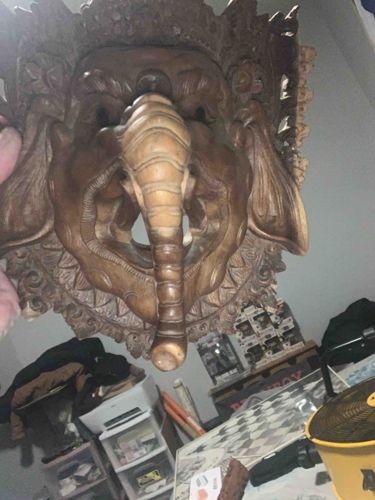
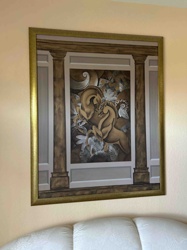
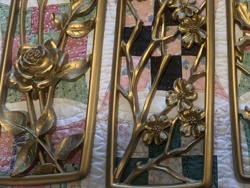
This appears to be a carved wooden wall hanging depicting the head of an elephant. The primary material is wood, exhibiting a rich, medium-brown tone with lighter accents, particularly on the trunk. The carving features significant depth and dimensionality, suggesting a high degree of craftsmanship. The elephant's face is rendered with prominent ears that fan out dramatically, textured with carved lines to simulate ear folds. Its trunk is a central feature, depicted curling downwards and slightly forward, with distinct segmentation and ridges that mimic the natural texture of an elephant's trunk. The tusks are not visible, suggesting they may be integrated into the design or intentionally omitted. Surrounding the elephant's head is an ornate border, possibly representing a headdress or a decorative frame, with intricate floral or geometric patterns carved in relief. The overall style suggests an origin from Southeast Asia, likely Bali or India, known for their detailed wood carving traditions. The wood exhibits a natural patina consistent with age and handling, with some areas appearing slightly lighter due to wear or natural variations in the wood grain. No obvious cracks, chips, or repairs are immediately visible from the provided image, but closer inspection would be required to confirm condition. The carving technique implies hand-craftsmanship, with individual details thoughtfully executed, such as the expressive eyes and the textured skin on the trunk and ears. The item's condition appears relatively good, with the surface having a soft sheen, possibly due to a wax finish or natural oils.
AI Appraisal Report
Based on my visual examination of the provided image, this Carved Wooden Elephant Head Wall Hanging appears to be a skillfully executed piece of decorative art. The deep carving, intricate detailing on the ears and trunk, and the ornate border all suggest hand-craftsmanship, likely originating from a region known for its wood carving traditions such as Southeast Asia (e.g., Bali, Thailand) or India. The rich, medium-brown wood tone and visible grain contribute to its aesthetic appeal. The condition appears to be relatively good, with a natural patina consistent with age and handling; no obvious cracks, chips, or significant repairs are discernible from the image. The soft sheen suggests a well-maintained surface, possibly waxed or oiled over time.
In terms of market conditions, decorative carved wooden art, particularly elephant motifs from these regions, enjoys consistent demand. While not rare, pieces exhibiting high quality craftsmanship and good condition are more desirable. Comparables found in online marketplaces, antique stores, and specialty home decor shops indicate a range for such items. The lack of visible tusks is a design choice that doesn't detract from its value. Factors positively impacting its value include the evident craftsmanship, dimensionality, and good apparent condition.
It is crucial to note that this assessment is based solely on photographic evidence. A full authentication would require in-person examination to verify the material (type of wood), assess the true condition (presence of minor scratches, repairs, or pest damage not visible in the photo), and confirm the carving technique more accurately. Without provenance documentation (origin, artist, date of creation), confirming authenticity beyond a stylistic match is impossible. Scientific testing of the wood could provide more definitive age information if required, but for a decorative piece of this nature, visual assessment is often sufficient for appraisal.