AI Appraisal Estimate

AI-generated estimates · not official valuations

From the user

What was submitted

Photo and notes provided by the user — not generated by AI

Submitted item photo
Submitted photo · June 4, 2026

User's notes

No additional notes provided.

AI analysis below

AI appraisal

AI analysis & estimate

AI-Generated · Verify before acting

Everything below is generated by AI for informational purposes only. AI can make mistakes — the AI may misidentify items or misattribute them (artist, maker, brand, designer, origin, era). This is not an official valuation and should not be used for insurance, sale, tax, estate, legal, or lending purposes — or any decision requiring a certified appraisal. It is not an authoritative claim about any person, brand, or rights holder — do not share or rely on it as a factual statement about a third party. Always consult qualified professionals before making financial decisions.

Read the full disclaimer

AI Identification

·Not independently authenticated·Verify before acting

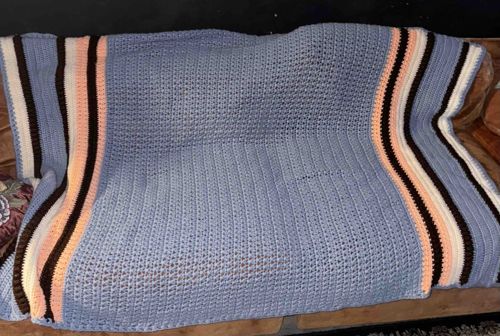
Hand-Crocheted Striped Afghan Blanket

Home Textiles / Hand-Crafted Bedding

AI Estimated Value

·Not an official valuation·Verify before acting

$45 - $65

As of June 4, 2026

AI Item Analysis

·AI can make mistakes·Verify before acting
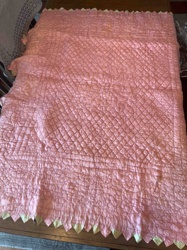
This is a rectangular hand-crocheted afghan blanket, appearing to be crafted from medium-weight acrylic or synthetic yarn, which was a standard material for household textiles in the late 20th century. The blanket features a prominent central field of medium dusty blue, worked in a consistent simple stitch—likely double crochet or a variation of the waffle stitch—giving it a textured, porous, and insulating quality. The primary blue body is flanked on both ends by a repetitive striped border pattern. These borders consist of horizontal stripes in contrasting colors including cream (off-white), soft peach or salmon pink, and a deep chocolate brown. The construction shows a high level of uniformity in stitch tension, indicating the work of an experienced hobbyist. The edges appear finished without a separate decorative fringe, maintaining a clean, modern geometric aesthetic. While there are no visible manufacturer tags or signatures, the style is quintessential of the 1970s or 1980s American folk craft movement. The condition appears fair to good locally; however, there is noticeable sagging or 'stretching' in the center of the textile, common in heavier crocheted items draped over furniture. No significant fraying, unraveling, or staining is immediately visible from a distance, though slight pilling of the yarn fibers may be present upon closer inspection due to the nature of the synthetic material used.
AI Appraisal Report

·AI can make mistakes·Verify before acting
I have examined the provided description and image of the Hand-Crocheted Striped Afghan. This piece is a classic example of late 20th-century American folk craft, likely dating from the 1970s or 1980s. The use of medium-weight synthetic yarn and the specific color palette—dusty blue, peach, and chocolate brown—is highly representative of that era. The stitch work demonstrates excellent tension and technical proficiency, suggesting an experienced artisan, though it follows a common domestic pattern rather than a unique artist-signed design. The condition is rated as Fair to Good. While the structural integrity remains intact, the noted 'sagging' in the central field suggests long-term use or improper storage, which affects the drape and display quality. The market for such items is currently driven by the 'Grandmillennial' and vintage-boho interior design trends. However, because these items were mass-produced at the hobbyist level, rarity is low. Comparables on secondary markets (e.g., Etsy or eBay) for standard rectangular acrylic afghans typically fall within the $40 to $80 range depending on size and complexity. Limitations: This appraisal is based on visual analysis alone. To provide a definitive valuation, an in-person inspection is required to check for hidden odors (smoke/pet), moth damage, or micro-fraying not visible in photographs. Furthermore, a burn test of a small fiber sample would be necessary to confirm the material composition (e.g., acrylic vs. wool blend). Provenance documentation identifying the specific maker or region of origin could marginally increase the value for local collectors of 20th-century Americana.

Get your items appraised

Instant estimates of your treasures with AI-powered appraisals

Browse More Appraisals