AI estimate as of September 1, 2025 · verify with a professional before acting
AI-Generated · Verify before acting
Everything on this page is generated by AI for informational purposes only. AI can make mistakes — the AI may misidentify items or misattribute them (artist, maker, brand, designer, origin, era). This is not an official valuation and should not be used for insurance, sale, tax, estate, legal, or lending purposes — or any decision requiring a certified appraisal. It is not an authoritative claim about any person, brand, or rights holder — do not share or rely on it as a factual statement about a third party. Always consult qualified professionals before making financial decisions.
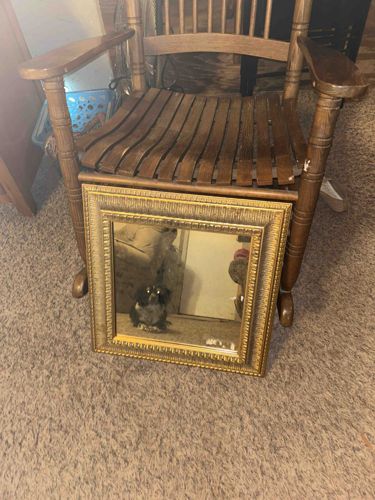
The item is a square-shaped decorative mirror featuring a prominent gold-gilded frame. The frame appears to be constructed from wood or a synthetic material engineered to mimic wood, finished with a rich gold paint or gilding that has a slightly antiqued or distressed appearance, suggesting wear consistent with age or design intent. The ornamentation on the frame consists of a repeating pattern of small, raised decorative elements, possibly beading or a reeded texture, which adds visual depth and a classic aesthetic. The mirror insert itself is reflective, and while its specific material (e.g., standard silvered glass, acrylic) cannot be definitively determined from the image, it exhibits good clarity as evidenced by the clear reflection of a small dog and the surrounding room. The overall condition of the frame shows some areas where the gold finish has chipped or worn away, revealing a darker underlayer, particularly noticeable on the edges and raised portions. These chips are not severe enough to compromise the integrity of the frame but contribute to its aged look. The craftsmanship suggests it is a mass-produced decorative item, likely from the late 20th or early 21st century, designed to emulate more ornate antique styles. There are no visible maker's marks or signatures. The size appears to be approximately 12-18 inches per side, a common dimension for accent mirrors.
AI Appraisal Report
Based on my visual examination of the provided image, this Gold Gilded Decorative Square Wall Mirror appears to be a mass-produced item. The gold-gilded frame, likely constructed from wood or a synthetic material, exhibits a repeating decorative pattern, suggesting a molded design common in decorative mirrors from the late 20th or early 21st century. The finish shows a deliberate antiqued or distressed appearance, though some areas of chipped gold revealing a darker underlayer indicate actual wear rather than solely intentional distressing. The overall condition is good, considering its likely age and type, with wear consistent with standard household use.
Authenticity: Without a physical inspection, specific material identification (e.g., solid wood vs. composite) and the exact nature of the 'gilding' (e.g., gold leaf vs. paint) cannot be definitively determined. The lack of visible maker's marks is typical for mass-produced decorative items of this nature. In-person examination would allow for closer inspection of material composition, construction methods, and confirmation of dimensional accuracy. Provenance documentation, though unlikely for such an item, would provide additional historical context. Scientific testing for material analysis is generally not warranted for items of this value.
Market Conditions and Comparables: The market for mass-produced decorative mirrors is robust, but flooded with similar items. New mirrors of comparable style and size can range from $50 to $150, while the secondary market typically sees these items priced lower due to wear and availability.
Demand and Rarity: There is general demand for decorative wall mirrors; however, items of this specific style and mass-produced quality are neither rare nor unique, which limits their secondary market value.
Factors Impacting Value: The primary factors impacting value are its mass-produced nature, lack of unique characteristics, and the minor finish wear. Its decorative appeal, while present, does not elevate it beyond typical consumer-grade home decor. The good clarity of the mirror insert is a positive, but expected.
Limitations: My valuation is based solely on the visual cues from the image. A physical inspection would confirm material integrity, actual size, and the precise level of wear and tear, which could slightly adjust the appraisal within the given range.