AI estimate as of October 26, 2025 · verify with a professional before acting
AI-Generated · Verify before acting
Everything on this page is generated by AI for informational purposes only. AI can make mistakes — the AI may misidentify items or misattribute them (artist, maker, brand, designer, origin, era). This is not an official valuation and should not be used for insurance, sale, tax, estate, legal, or lending purposes — or any decision requiring a certified appraisal. It is not an authoritative claim about any person, brand, or rights holder — do not share or rely on it as a factual statement about a third party. Always consult qualified professionals before making financial decisions.
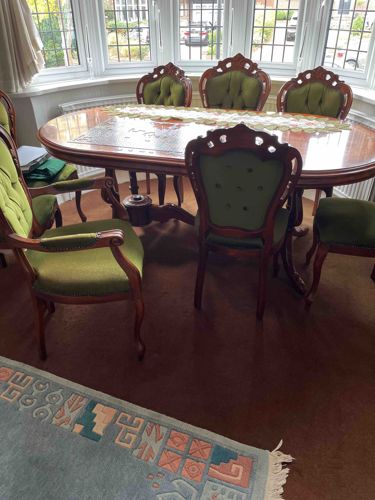
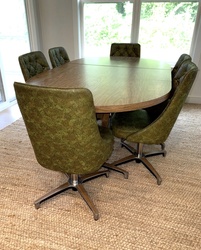
This item is a vintage dining set comprising an oval-shaped dining table and at least six matching chairs, all crafted from what appears to be a dark-stained hardwood, possibly mahogany or a similar rich-toned wood. The table features an ornate pedestal base with fluted details and multiple curved supports, contributing to its generally robust appearance. The tabletop itself is polished to a high sheen, reflecting light, and a detailed, possibly embroidered or lace, table runner adorns its center. The chairs are particularly distinctive, featuring elaborate carved wooden frames with rococo-style scrolling and pierced details on the crest rails, which are topped with elegant shell or acanthus leaf motifs. The upholstery on all chairs is a vibrant, possibly velvet or velour, olive-green fabric. The seat backs are button-tufted, adding to their plush and traditional aesthetic, while the seats are generously padded. At least one chair, in the foreground, is an armchair with carved armrests, indicating it might be a 'host' or 'hostess' chair, distinguishable from the side chairs. The overall condition appears to be good for a vintage piece, showing a consistent patina on the wood due to age and use, but no major visible damage or repairs are apparent from the provided images. The wood finish seems well-maintained, and the upholstery, while potentially aged, does not show obvious tears or significant stains. The style suggests a period between the late 19th century and mid-20th century, likely leaning towards a Baroque Revival or Rococo Revival aesthetic, emphasizing intricate carving and luxurious textiles. The craftsmanship appears to be of a reasonable quality, with attention paid to decorative details and solid construction, indicative of furniture meant for formal dining.
AI Appraisal Report
Upon examining the provided image of this Vintage Carved Wood Dining Set with Green Upholstery, I assess it to be a charming example of a Baroque or Rococo Revival piece, likely dating from the early to mid-20th century. The elaborate carvings on both the table's pedestal base and the chairs' crest rails, featuring shell and acanthus leaf motifs, are hallmarks of these revival styles. The dark-stained hardwood, possibly mahogany, appears to be in good condition for its age, displaying a consistent patina and high sheen on the tabletop. The olive-green velvet or velour upholstery, with its button-tufted backs, adds to the set's luxurious and traditional appeal. The presence of at least one host/hostess armchair further enhances its value as a complete, formal dining set.
From the visual evidence, the condition appears good; I see no obvious major damage, repairs, or significant upholstery tears. However, without a physical inspection, I cannot ascertain the structural integrity of the joints, the condition of the internal padding, or the extent of any minor scratches, dents, or veneer lifting. Market conditions for vintage carved dining sets with opulent styling are stable, with demand driven by those seeking characterful, well-made furniture as an alternative to contemporary mass-produced items. While not exceedingly rare, sets in this complete and seemingly well-preserved condition are desirable. Factors impacting value positively include the intricate carving and the apparent good condition. The main limitation in my assessment is the inability to conduct a tactile examination. A physical inspection would allow me to confirm the wood type definitively, verify structural soundness, inspect for hidden repairs, and assess the true condition of the upholstery and finish. Provenance documentation, if available, could further authenticate its history and origin.