AI estimate as of September 22, 2025 · verify with a professional before acting
AI-Generated · Verify before acting
Everything on this page is generated by AI for informational purposes only. AI can make mistakes — the AI may misidentify items or misattribute them (artist, maker, brand, designer, origin, era). This is not an official valuation and should not be used for insurance, sale, tax, estate, legal, or lending purposes — or any decision requiring a certified appraisal. It is not an authoritative claim about any person, brand, or rights holder — do not share or rely on it as a factual statement about a third party. Always consult qualified professionals before making financial decisions.
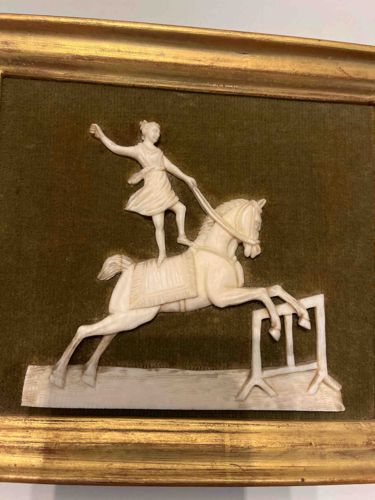
This item is a framed relief carving depicting an equestrian scene, likely from the 19th or early 20th century. The carving, appearing to be crafted from ivory or bone due to its fine grain, smooth surface, and characteristic off-white color, features a female rider standing atop a rearing horse. The rider is dressed in what appears to be classical attire, a short tunic-like dress, with her hair pulled back, and her right arm raised as if holding something or gesturing. Her left hand seems to be holding reins, creating a dynamic pose as the horse is depicted mid-jump over a low hurdle. The horse itself exhibits detailed musculature and a stylized mane and tail. A saddle blanket with incised decorative lines is visible on its back. The entire carved scene is mounted against a dark, possibly olive-green velvet or felt backing, which provides a strong contrast to the pale carving. The assembly is housed within a gilded wooden frame with a classical profile, showing signs of age with some wear and tarnishing to the gold finish. The carving itself appears to be in good condition, with no obvious major breaks or losses, though minor surface wear or discoloration consistent with age might be present upon closer inspection. The craftsmanship indicates a skilled artisan, with delicate carving defining facial features, drapery on the rider's garment, and the horse's anatomy. The overall style is reminiscent of neoclassical or Victorian decorative arts that often incorporated such allegorical or theatrical themes.
AI Appraisal Report
Based on my visual examination of the provided image, this framed relief carving of an equestrian figure presents as a charming piece of decorative art, likely dating from the late 19th to early 20th century. The material, with its fine grain, smooth surface, and off-white hue, strongly suggests ivory or bone, consistent with pieces from this period. The craftsmanship is commendable, displaying delicate carving of the rider's features, drapery, and the horse's musculature, indicative of a skilled artisan. The piece appears to be in good condition, with no obvious major breaks or losses visible in the image. The gilded frame, while showing some age-consistent wear and tarnishing, complements the carving and period aesthetic well. The dark velvet backing accentuates the pale carving effectively.
Market conditions for such late Victorian or neoclassical decorative carvings, especially those in good condition and of a manageable size, tend to be steady. Comparables often include similar framed ivory or bone carvings depicting classical or allegorical scenes. Demand for these pieces is moderate, driven by collectors of period decorative arts and those seeking unique wall decor. The carving's apparent good condition and skilled execution are positive value drivers.
However, a significant limitation in authenticity verification from an image alone is the definitive identification of the material. While it exhibits characteristics of ivory or bone, a physical examination or scientific testing (such as a Schreger line test for ivory, or microscopic analysis for bone) would be crucial to confirm its composition and comply with regulations concerning ivory trade, which could significantly impact marketability and legal ownership. Additionally, an in-person inspection would allow for a thorough assessment of any minor surface wear, discoloration, or hidden repairs not discernible from photographs. Provenance documentation, if available, would also add to its historical context and value. Considering all these factors, I would place the appraisal value for this piece at $600-900.