AI estimate as of August 15, 2025 · verify with a professional before acting
AI-Generated · Verify before acting
Everything on this page is generated by AI for informational purposes only. AI can make mistakes — the AI may misidentify items or misattribute them (artist, maker, brand, designer, origin, era). This is not an official valuation and should not be used for insurance, sale, tax, estate, legal, or lending purposes — or any decision requiring a certified appraisal. It is not an authoritative claim about any person, brand, or rights holder — do not share or rely on it as a factual statement about a third party. Always consult qualified professionals before making financial decisions.
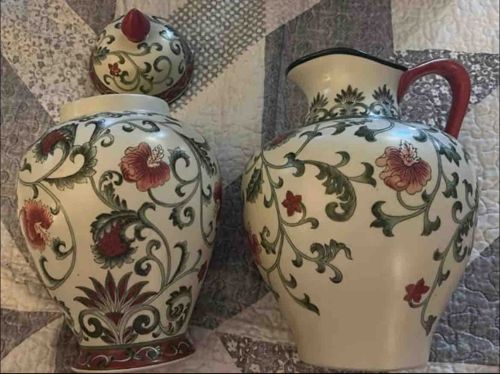
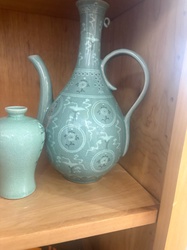
This is a pair of decorative ceramic vessels, likely a ginger jar with its lid and a matching pitcher, featuring an ornate floral and foliate design. Both pieces have an off-white or cream base color. The primary decoration consists of intricate scrolling vines, leaves, and large stylized flowers, predominantly in shades of dark green, muted red, and pink. The ginger jar, on the left, has a bulbous body tapering slightly towards the rim and a prominent foot. Its lid, visible removed from the jar, mirrors the body's decoration and features a reddish finial. The pitcher, on the right, has a similar bulbous body, a wide rim with a spouted opening, and a distinct C-shaped handle in a matching muted red color. The rim of the pitcher appears to have a dark, possibly black, accent band. The base of the ginger jar also shows a decorative band with similar colors and motifs. The craftsmanship appears to be of good quality, with consistent brushwork and even glazing. There are no obvious signs of chips, cracks, or repairs visible from the provided image, though minor surface wear or crazing might be present but are not discernible. The style suggests an Asian influence, possibly Chinoiserie, and the pieces appear to be relatively modern reproductions or decorative items, likely from the late 20th or early 21st century. The overall aesthetic is decorative and vibrant, intended for display.
AI Appraisal Report
Upon visual examination of the provided image, I assess this pair of floral decorated ceramic ginger jar and pitcher. The condition appears to be very good; I do not observe any chips, cracks, or significant visible wear. The colors are vibrant, and the glazing seems consistent. Authenticity is challenging to confirm solely from an image, but the style suggests a decorative, mass-produced item with Chinoiserie influence, likely dating from the late 20th to early 21st century. These are not antique or rare pieces.
Market conditions for such decorative ceramics are generally stable, with a modest demand primarily from buyers looking for accent pieces rather than collectible art. Comparables would include similar new or gently used decorative ceramic sets found in home goods stores or online marketplaces, often manufactured in Asia. These items are not rare; many similar styles are widely available, which limits their market value. Factors impacting value are primarily aesthetic appeal and condition. There is no significant historical or artistic provenance evident.
Limitations in authenticity verification are significant. Without a physical examination, I cannot properly assess provenance markings, manufacturing quality, or detect subtle signs of age such as crazing or specific firing techniques. An in-person inspection would allow for tactile assessment, examination of bases for maker's marks or stamps, and a more precise determination of age and manufacturing origin. Scientific testing, if needed, would involve material analysis for composition and dating, but this is typically reserved for higher-value, genuinely antique pieces. For these items, provenance documentation (e.g., original purchase receipts) would be the primary means of confirming manufacturing origin if it were ever in doubt, though it's unlikely to impact value significantly for this type of item.