AI estimate as of October 7, 2025 · verify with a professional before acting
AI-Generated · Verify before acting
Everything on this page is generated by AI for informational purposes only. AI can make mistakes — the AI may misidentify items or misattribute them (artist, maker, brand, designer, origin, era). This is not an official valuation and should not be used for insurance, sale, tax, estate, legal, or lending purposes — or any decision requiring a certified appraisal. It is not an authoritative claim about any person, brand, or rights holder — do not share or rely on it as a factual statement about a third party. Always consult qualified professionals before making financial decisions.
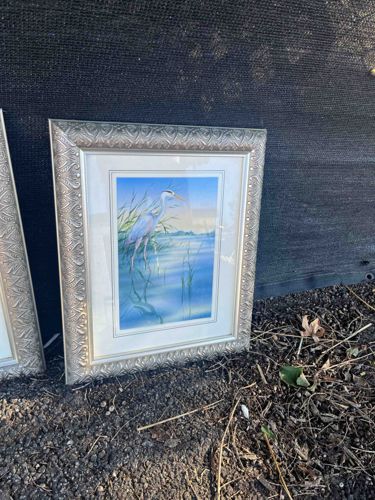
This item is a framed art print featuring a coastal scene with two herons. The print itself depicts a calm body of water, likely a marsh or shallow bay, rendered in varying shades of blue with reflections. Two light-blue feathered herons are prominently featured, standing amidst tall green and yellow-green reeds or marsh grass. The background shows a soft transition from the water to a distant horizon with a pale yellow or light orange sky suggesting either sunrise or sunset. The print is housed within a substantial frame that appears to be made of carved or molded wood with a metallic, possibly silver or champagne gold, finish. The frame features an ornate, repeating pattern of scrolls and leaf motifs, giving it a somewhat Baroque or Rococo-inspired aesthetic. Inside the main frame, there is a prominent white matboard, which acts as a border around the print, providing visual separation and enhancing the artwork. The surface covering the print is clear, likely glass or acrylic, which shows some reflections from the ambient light, indicating its protective nature. The overall condition appears to be good from the visible angles, with no obvious signs of damage to the frame, mat, or print itself, though a thorough inspection for scratches, dings, or discoloration would be necessary for a complete appraisal. The frame's finish seems intact, and the mat board is clean. The print itself shows good color saturation and detail, suggesting it is a commercial-grade art reproduction, possibly a giclée or offset lithograph. The style points towards decorative home art, likely from the late 20th or early 21st century.
AI Appraisal Report
Upon visual examination of the provided image, this framed coastal heron art print appears to be in good overall condition. The print exhibits good color saturation and detail, consistent with a commercial-grade reproduction, likely an offset lithograph or giclée. The frame, with its ornate metallic finish and Baroque/Rococo-inspired motifs, shows no obvious signs of damage, dings, or significant wear. The white matboard is clean and provides effective visual separation. The protective glazing is intact, though reflections prevent a full assessment of its clarity. Physically, the item presents well as decorative home art.
Authenticity, in terms of being an original artwork, cannot be determined from the image alone. This is clearly a print, and without physical inspection, I cannot verify printmaking techniques (e.g., whether it's a giclée, lithograph, etc.), nor can I identify any artist signature or edition number which would influence value. An in-person examination would allow me to check for original medium, artist signatures, edition numbers, and the quality of the print medium. Provenance documentation could offer insights into its origin and artist, if any.
Demand for decorative coastal art is generally steady, with herons being a popular motif. However, the market for mass-produced framed prints, even those in good condition and with ornate frames, tends to be modest. Similar decorative prints of this size and style typically retail new in the $100-$300 range, with secondary market values often significantly lower. The ornate frame adds to its decorative appeal but given its likely molded construction, it doesn't significantly elevate value beyond its aesthetic contribution. Rarity is not a factor here; such prints are widely available.
Factors impacting value include its good condition and pleasing aesthetic as a decorator item. The primary limiting factor is its nature as a decorative print rather than an original artwork or a limited-edition piece by a known artist, which often command higher prices. Without direct verification of the artist or print process, the value remains in the decorative art category.