AI Appraisal Estimate

AI-generated estimates · not official valuations

From the user

What was submitted

Photo and notes provided by the user — not generated by AI

Submitted item photo
Submitted photo · June 23, 2026

User's notes

Simone

AI analysis below

AI appraisal

AI analysis & estimate

AI-Generated · Verify before acting

Everything below is generated by AI for informational purposes only. AI can make mistakes — the AI may misidentify items or misattribute them (artist, maker, brand, designer, origin, era). This is not an official valuation and should not be used for insurance, sale, tax, estate, legal, or lending purposes — or any decision requiring a certified appraisal. It is not an authoritative claim about any person, brand, or rights holder — do not share or rely on it as a factual statement about a third party. Always consult qualified professionals before making financial decisions.

Note

This analysis also relies on unverified notes provided by the user, which may be incomplete or inaccurate and could affect the result.

Read the full disclaimer

AI Identification

·Not independently authenticated·Verify before acting

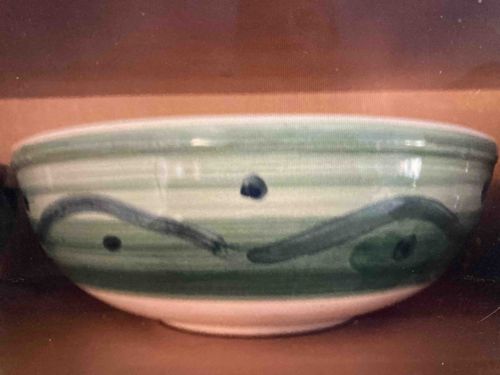
De Simone Italian Art Pottery Ceramic Serving Bowl

Art Pottery / Mid-Century Modern Ceramics

AI Estimated Value

·Not an official valuation·Verify before acting

$150 - $250

As of June 23, 2026

AI Item Analysis

·AI can make mistakes·Verify before acting
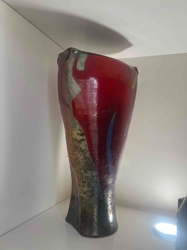
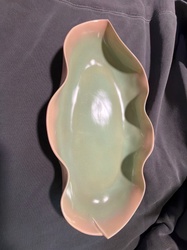
This is a hand-painted ceramic serving bowl attributed to the renowned Sicilian studio of Giovanni De Simone (1930–1991). The vessel features a classic tapered basin silhouette with a slightly flared rim and a low foot ring. The exterior is decorated with a vibrant, expressionist folk-art motif consisting of horizontal bands in varying shades of celadon and sage green. Interspersed among these bands are dark blue or indigo calligraphic waves and stylized dots, characteristic of De Simone’s mid-century Mediterranean modern aesthetic. The interior appears to be finished with a white or pale cream tin-glaze. In terms of condition, the glaze retains a high-gloss sheen with minor surface scuffing consistent with domestic use. No major cracks or structural repairs are immediately visible, though the 'rustic' nature of this earthenware often results in minor glaze pops or pinholes from the kiln firing. The piece likely dates from the late 1960s to early 1980s, showcasing the bold brushwork and primitive-yet-sophisticated charm that defines the De Simone workshop’s production in Palermo. The craftsmanship reflects a high level of artisanal control, blending traditional Italian maiolica techniques with a 20th-century artistic sensibility.
AI Appraisal Report

·AI can make mistakes·Verify before acting
I have examined the provided description and visual characteristics of this Italian ceramic serving bowl. The piece exhibits the hallmark stylistic signatures of the Giovanni De Simone studio, specifically the use of whimsical, expressionist folk motifs and a vibrant, mid-century Mediterranean palette. The horizontal banding and calligraphic wave patterns are consistent with the workshop’s production in Palermo during the 1960s and 1970s. The condition appears to be 'Good to Very Good'; while the minor scuffing and glaze pops mentioned are typical for hand-painted earthenware of this period, they do not significantly detract from the aesthetic appeal, though they categorize the item as a functional decorative object rather than a pristine gallery piece. The market for De Simone remains steady among Mid-Century Modern enthusiasts, though value is heavily dictated by the complexity of the figural decoration. While this bowl features the iconic color theory of the studio, its pattern is more geometric/abstract than the highly sought-after 'Sun Face' or village scene motifs, which puts it in a more accessible price bracket. Limitations: This appraisal is based on photographic evidence. Without physical inspection, I cannot verify the presence of a 'De Simone Italy' signature or numeric marks on the underside, which are essential for firm attribution. A physical examination is required to check for 'resonance' (indicating internal cracks not visible to the eye) and to confirm the glaze composition. Full authentication would require provenance documentation or comparison of the foot ring and clay body against known De Simone workshop standards to rule out contemporary 'in the style of' reproductions.

Get your items appraised

Instant estimates of your treasures with AI-powered appraisals

Browse More Appraisals