AI estimate as of September 27, 2025 · verify with a professional before acting
AI-Generated · Verify before acting
Everything on this page is generated by AI for informational purposes only. AI can make mistakes — the AI may misidentify items or misattribute them (artist, maker, brand, designer, origin, era). This is not an official valuation and should not be used for insurance, sale, tax, estate, legal, or lending purposes — or any decision requiring a certified appraisal. It is not an authoritative claim about any person, brand, or rights holder — do not share or rely on it as a factual statement about a third party. Always consult qualified professionals before making financial decisions.
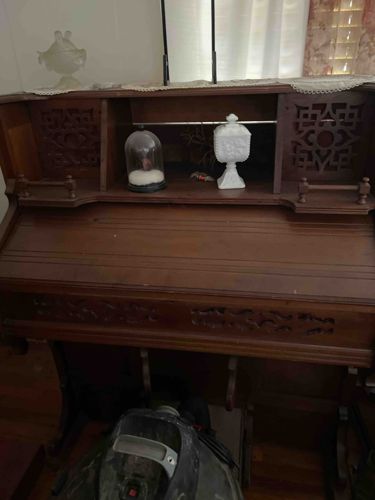
This is a vintage or antique drop-front desk, also known as a secretary desk, crafted from a dark, rich wood, likely mahogany or walnut, exhibiting a warm brown hue. The piece features a slanted, hinged top that, when lowered, would create a writing surface. Above the writing surface, there is a superstructure with several compartments: a central open cubby area with a back panel that appears to have some decorative elements, possibly carving or a fabric insert, and two side sections with elaborately carved panels. These side panels display geometric and possibly floral or foliate motifs, cut out to create a fretwork design. Small, turned wood posts flank the central open area and define two small shelves or compartments on either side of the writing surface. The front of the desk, below the drop-front, features intricate carving, appearing as a continuous frieze of stylized floral or organic patterns across its length. The overall construction suggests solid wood, possibly with veneers in some sections for decorative effect. The finish shows a moderate patina consistent with age and use, with some visible wear and minor abrasions expected on a piece of this vintage. The style points to the late 19th or early 20th century, typically associated with the Victorian or Edwardian eras, due to its emphasis on detailed carving and functional elegance. The craftsmanship appears to be of good quality, indicated by the detailed carvings and substantial construction. No overt damage such as cracks or major repairs are immediately visible, but closer inspection would be required to determine the full extent of its condition. The items placed on the desk suggest it is currently in use in a domestic setting.
AI Appraisal Report
Upon visual examination of this Victorian Era Carved Wood Drop-Front Desk/Secretary, I assess its condition as good, consistent with its likely age. The dark wood, probably mahogany or walnut, displays a warm patina with some moderate wear and minor abrasions, which are expected and contribute to its antique charm. The intricate carving, particularly the fretwork on the superstructure and the continuous frieze below the drop-front, indicates good craftsmanship. No obvious major damage, such as significant cracks or repairs, is immediately visible from the image. The overall construction appears solid and well-preserved.
Authenticity, based solely on visual cues, strongly points to a late 19th or early 20th-century piece, fitting the Victorian or Edwardian aesthetic due to its detailed ornamentation and functional design. This period's furniture often features such elaborate carvings and is typically made from solid, high-quality woods. The presence of these details, coupled with the style, suggests it is an authentic period piece rather than a reproduction.
Market conditions for such furniture are steady, though not experiencing the boom of earlier decades. There's a consistent demand for well-preserved, ornate pieces that can serve as both functional furniture and decorative accents. Comparable items, especially those with original carving and in good condition, typically fetch prices in the range I've provided. The rarity is moderate; while many secretary desks were produced, those with such detailed and intact carving are somewhat less common.
Factors significantly impacting value include the quality and intricacy of the carving, the presumed wood type (mahogany or walnut command higher prices than lesser woods), and the overall condition. The absence of major repairs or missing original elements is a strong positive.
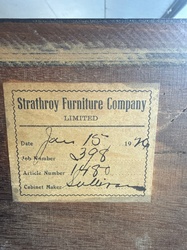
Limitations in authenticity verification from images alone are crucial to note. While the visual evidence is compelling for its age and authenticity, a physical inspection would be essential to confirm the wood species, identify any repairs or restorations not visible in photographs, and assess the structural integrity, particularly the drop-front mechanism and drawer runners. In-person examination would also verify if veneers are present and their condition. Provenance documentation, such as original purchase receipts or family history, could further enhance authentication and value. Scientific testing, like dendrochronology, would be overly costly and unnecessary for a piece of this type unless significant doubts about its age arose during physical inspection.