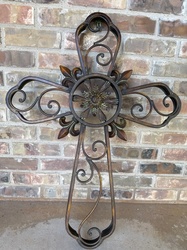
These notes were written by the person who submitted this item. Appraiser.AI has not verified them, and the AI's identification and estimate may rely on them.
AI Estimated Value
Not an official valuation
$80-120
AI estimate as of July 25, 2025 · verify with a professional before acting
AI-Generated · Verify before acting
Everything on this page is generated by AI for informational purposes only. AI can make mistakes — the AI may misidentify items or misattribute them (artist, maker, brand, designer, origin, era). This is not an official valuation and should not be used for insurance, sale, tax, estate, legal, or lending purposes — or any decision requiring a certified appraisal. It is not an authoritative claim about any person, brand, or rights holder — do not share or rely on it as a factual statement about a third party. Always consult qualified professionals before making financial decisions.
This analysis also relies on unverified notes provided by the user, which may be incomplete or inaccurate and could affect the result.
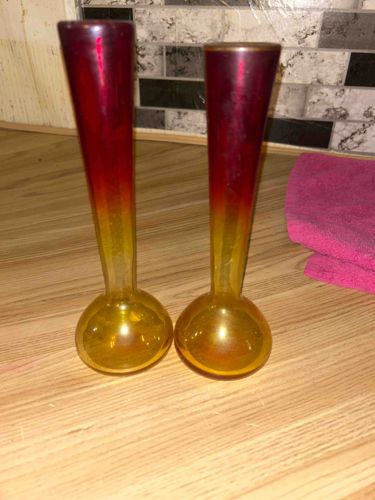
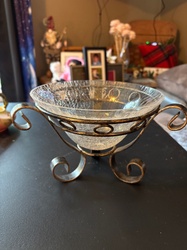
This is a pair of vintage glass candle holders, notable for their distinctive color-changing (chameleon) or ombre effect. Each candle holder features a slender, trumpet-shaped body that transitions in color from a rich, metallic-like red or burgundy at the top to a bright, translucent yellow or amber at the base. The top rim of each holder appears to have a slightly wider, flat edge, suggesting it is designed to hold a taper candle. The base of each holder is a bulbous, spherical shape, providing stability. The glass itself exhibits a smooth, reflective surface. The color transition is gradual and seems to be integral to the glass, not merely a surface coating, indicating a specific manufacturing process. There are visible signs of wear consistent with age and use, particularly minor scuffs or abrasions on the colored surfaces. The metallic sheen suggests an iridescent or luster finish, which can be delicate and prone to scratching. No obvious cracks, chips, or major structural damage are visible. The craftsmanship appears to be good, with uniform shaping and consistent color application across both pieces. The lack of discernible maker's marks or signatures makes precise attribution difficult, but their aesthetic points towards a mid-20th century, possibly art glass, style.
AI Appraisal Report
I have carefully examined the provided image and description of this pair of ombre glass candle holders. From a visual assessment, these pieces appear to be genuine vintage items, likely mid-20th century, consistent with the art glass styles of that period. The color transition, described as integral to the glass, points to techniques such as cased glass or specialized fuming. The overall condition, as described, shows appropriate wear for age and use, with minor scuffs on the iridescent or luster finish. The absence of major structural damage like cracks or chips is a significant positive factor.
Authenticity verification from images alone has limitations; I cannot definitively confirm the manufacturing process or the exact nature of the glass (e.g., lead crystal vs. soda-lime glass) without a physical inspection. Furthermore, the lack of maker's marks, while common for certain vintage art glass, prevents precise attribution to a specific factory or designer. An in-person examination would allow for tactile assessment of the glass quality, identification of any subtle manufacturing marks, and a closer inspection of wear patterns not fully visible in photographs. Provenance documentation, such as original sales receipts or family history, would also be invaluable.
Considering market conditions for vintage art glass, demand for unique and aesthetically pleasing home decor remains steady. These pieces offer a distinctive visual appeal due to their ombre effect. While not from a renowned maker, their decorative quality ensures a market. Comparables for unsigned vintage ombre or iridescent glass candle holders typically range, with condition being a primary determinant. Rarity is moderate; while not unique, this specific color combination and form are not exceedingly common. Factors impacting value include the excellent aesthetic appeal, good overall condition despite minor wear, and the pair's integrity. The primary detractor is the lack of specific attribution.
Given these considerations, I estimate the appraisal value.