AI estimate as of October 3, 2025 · verify with a professional before acting
AI-Generated · Verify before acting
Everything on this page is generated by AI for informational purposes only. AI can make mistakes — the AI may misidentify items or misattribute them (artist, maker, brand, designer, origin, era). This is not an official valuation and should not be used for insurance, sale, tax, estate, legal, or lending purposes — or any decision requiring a certified appraisal. It is not an authoritative claim about any person, brand, or rights holder — do not share or rely on it as a factual statement about a third party. Always consult qualified professionals before making financial decisions.
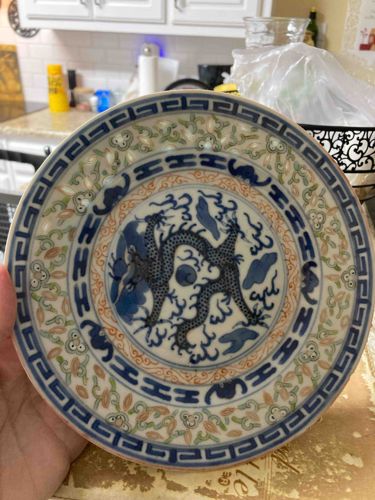
This item is a circular porcelain plate, likely of Chinese origin, characterized by its intricate hand-painted decoration. The dominant colors in the design are various shades of blue, encompassing a deep cobalt tone, complemented by softer blues, alongside earthy orange-browns and subtle greens, all set against a white or off-white porcelain body. The central motif features two robust dragons, depicted in a dark blue, almost black speckled appearance, seemingly swirling amidst lighter blue cloud-like elements. These dragons exhibit traditional serpentine bodies, with visible scales and stylized heads. Surrounding the central medallion is a band with a geometric 'H' or key-fret pattern rendered in blue, accented by thin orange-brown lines. The outer rim of the plate showcases a more elaborate folk-art inspired floral or vine pattern with stylized leaves and possibly lingzhi mushroom motifs, primarily in muted greens and orange-browns, interspaced with small blue elements. The outermost edge of the plate is bordered by another geometric pattern, a blue Greek key or meander design, which frames the entire composition. The construction appears to be high-quality ceramic, likely porcelain, with a smooth, glazed finish. The painting style suggests a traditional, possibly antique or vintage piece, though an exact age is difficult to determine without examining the base and manufacturing marks. There are no immediately visible cracks, chips, or significant repairs in the provided image; however, closer inspection would be required to assess the full condition and any potential wear, crazing, or loss of pigment. The craftsmanship appears detailed, indicative of careful hand-painting rather than mass production decals, showcasing fine lines and varied color applications.
AI Appraisal Report
I have examined the image of this Chinese Porcelain Dragon Motif Plate. Visually, it presents as a well-crafted piece, likely of antique or vintage origin, given the traditional design elements and hand-painted aesthetic. The condition appears good from the image; I did not observe any immediate cracks, chips, or significant repairs. The quality of the hand-painting, with its varied blues, earthy orange-browns, and greens, against the white porcelain, suggests a good level of artistry and attention to detail, characteristic of traditional Chinese porcelain production rather than modern mass-produced decals. The intricate dragon motif and surrounding geometric and floral patterns are well-executed.
Authenticity, however, is a significant limitation based solely on this image. While the style is indicative, true authentication requires an in-person examination. I would need to inspect the base for maker's marks, reign marks, or other identifying features, and assess the porcelain body for typical age-related wear, crazing, and the firing process. Provenance documentation, if available, would also be crucial. Without these, it's difficult to definitively confirm an exact production period or origin. Market conditions for decorative Chinese porcelain of this style are generally stable for genuine antique pieces, with demand depending on rarity, condition, and provenance. For a decorative plate of this apparent quality and visual appeal, assuming it is a genuine older piece, comparables suggest a value in the stated range. If it were definitively identified as a rare or significant antique, the value could be considerably higher. Conversely, if it proves to be a more modern decorative reproduction, the value would be lower.