These notes were written by the person who submitted this item. Appraiser.AI has not verified them, and the AI's identification and estimate may rely on them.
AI Estimated Value
Not an official valuation
$150 - $300
AI estimate as of November 7, 2026 · verify with a professional before acting
AI-Generated · Verify before acting
Everything on this page is generated by AI for informational purposes only. AI can make mistakes — the AI may misidentify items or misattribute them (artist, maker, brand, designer, origin, era). This is not an official valuation and should not be used for insurance, sale, tax, estate, legal, or lending purposes — or any decision requiring a certified appraisal. It is not an authoritative claim about any person, brand, or rights holder — do not share or rely on it as a factual statement about a third party. Always consult qualified professionals before making financial decisions.
This analysis also relies on unverified notes provided by the user, which may be incomplete or inaccurate and could affect the result.
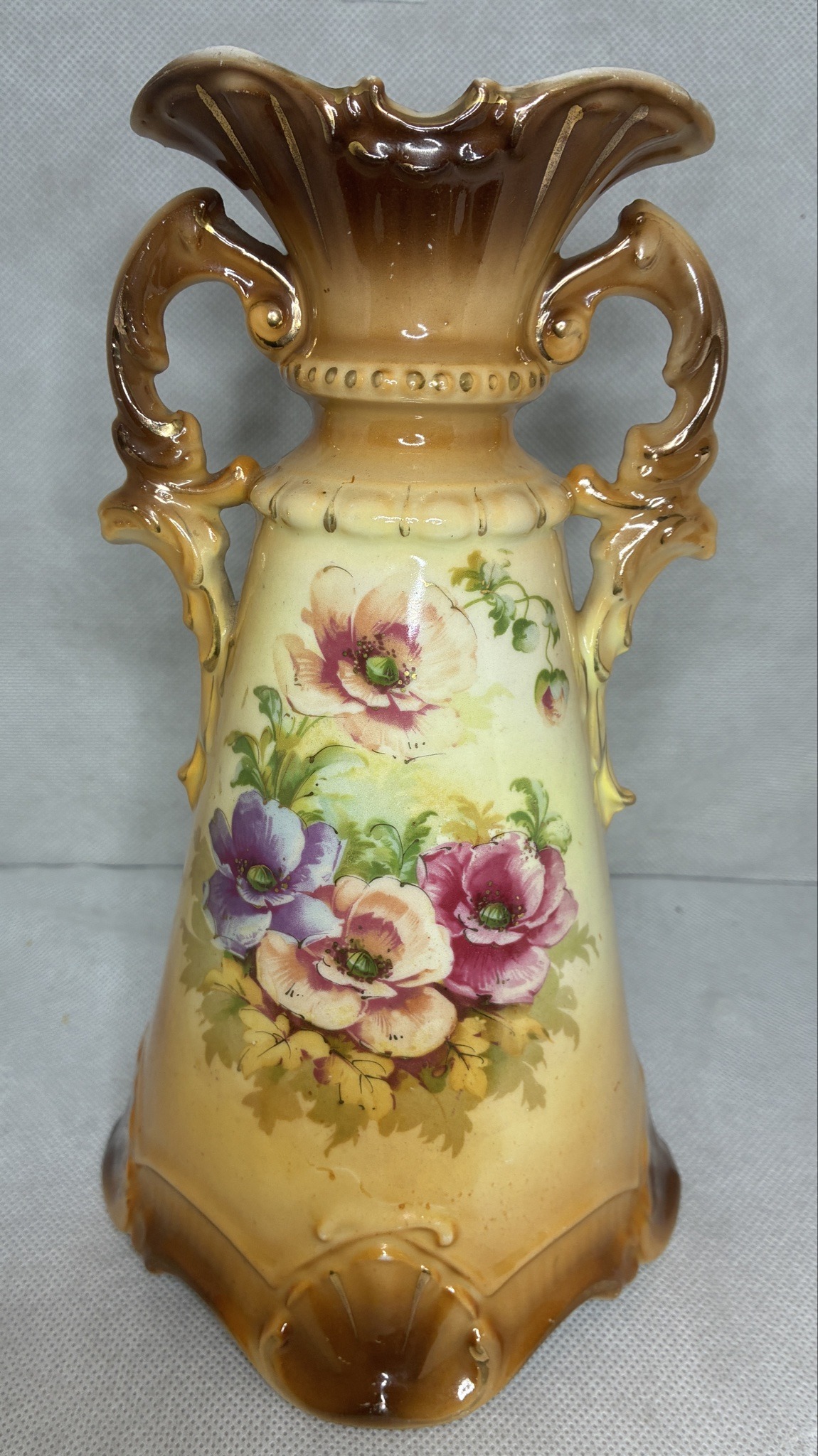
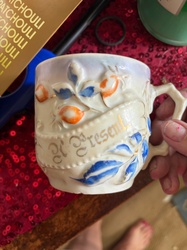
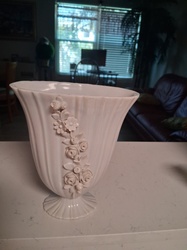
This decorative porcelain mantle vase exhibits physical characteristics consistent with late 19th- or early 20th-century European ceramic production, often associated with Austro-Bohemian manufacturing centers. The piece is constructed from glazed porcelain, featuring an asymmetrical, heavily sculpted form with a flared, scalloped rim and a tapered body resting on a lobed, pedestal foot. Prominent scroll-form handles flank the upper neck, embellished with gilded accents. The color palette transitions from a deep, rich brown wash at the base and rim to a soft cream and pale yellow gradient across the central body. A hand-painted or transfer-printed floral motif featuring poppies in shades of magenta, purple, peach, and white, accompanied by green foliage, is centered on the front facing. The rim, handles, and lower molding display applied metallic gold accents with some areas of visible wear and rubbing. There are no clearly legible maker's marks, stamps, or signatures visible in the provided image, and the attribution relies entirely on stylistic conventions. The owner's unverified context describes the object as an Austrian double-handled porcelain mantle vase measuring approximately 24.5 cm in height, 15 cm in diameter, and weighing 600 grams, acquired for $8.99. The overall condition appears generally intact with expected surface wear, minor loss to the gilding, and subtle crazing appropriate for an aged ceramic piece. Quality indicators include the detailed relief molding of the handles and the soft gradient shading, though lack of visible marks leaves specific origin and workshop unauthenticated.
AI Appraisal Report
Based on what I can see in the provided image, this decorative mantle vase exhibits physical characteristics consistent with late 19th- or early 20th-century Austro-Bohemian ceramic production. The owner identifies this as an Austrian double-handled porcelain mantle vase measuring approximately 24.5 cm in height, 15 cm in diameter, and weighing 600 grams. I can't verify from a photo whether the piece is truly of Austrian origin or the exact period of manufacture, as no clear maker's marks or stamps are visible to support a precise attribution. The piece features a heavily sculpted form, scroll-form handles with gilded accents, and a hand-painted or transfer-printed floral poppy motif against a gradient ground. The overall condition appears generally intact, though I note surface wear, minor loss to the gilding, and subtle crazing appropriate for an aged ceramic item. Would need physical inspection to confirm the porcelain body, glaze characteristics, and any subtle hallmarks that might be obscured in the photographs. Assuming the working hypothesis that this is a period Austro-Bohemian piece, comparable decorative ceramics of this type typically trade in the $150 to $300 range in the current secondary market, depending heavily on decorative appeal and condition. Demand for late-nineteenth and early-twentieth-century decorative European ceramics remains modest but steady among interior decorators and collectors of Victorian-era wares. If further evaluation reveals the item is a later reproduction, replica, or made 'in the style of' rather than a period piece, the value would likely decrease significantly, falling closer to the owner's acquisition cost of $8.99 or nominal decorative value. To fully evaluate and support the attribution, physical examination by an expert appraiser, detailed hallmark analysis, and consideration of provenance documentation would be required.