AI estimate as of September 22, 2025 · verify with a professional before acting
AI-Generated · Verify before acting
Everything on this page is generated by AI for informational purposes only. AI can make mistakes — the AI may misidentify items or misattribute them (artist, maker, brand, designer, origin, era). This is not an official valuation and should not be used for insurance, sale, tax, estate, legal, or lending purposes — or any decision requiring a certified appraisal. It is not an authoritative claim about any person, brand, or rights holder — do not share or rely on it as a factual statement about a third party. Always consult qualified professionals before making financial decisions.
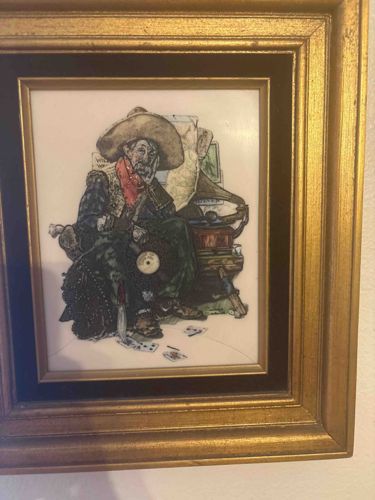
This item is a framed decorative tile featuring an illustration of a 'Mexican Gambler with Phonograph'. The tile depicts an aged man, presumably a gambler, wearing a wide-brimmed sombrero and a red bandana. He appears to be seated, perhaps casually or after a game, with playing cards scattered around his feet, suggesting a recent or ongoing game. To his right, an antique phonograph with a large horn is visible, indicating a setting from the late 19th or early 20th century. The illustration employs a muted color palette with dominant greens, browns, and dark tones for the figure's clothing, contrasted by the red bandana and the naturalistic colors of the phonograph. The image itself is rendered with a detailed, almost etched quality, showcasing fine lines and textures, particularly in the clothing and facial features of the gambler. The tile is set within a multi-layered frame. The innermost layer is a dark, possibly black or very dark brown, narrow border that directly surrounds the tile. This is followed by a wider, ornate gold-toned frame with visible relief detailing, suggesting a traditional or classic aesthetic. The gold frame exhibits some wear, including minor scuffs and potentially some loss of finish, consistent with handling and age. The tile itself appears to be in good condition, with no immediately visible cracks, chips, or significant discoloration. The overall aesthetic suggests a piece intended for decorative display, possibly reflecting a Western or Southwestern theme. The distinct style of illustration and the thematic content make it a unique collectible.
AI Appraisal Report
Upon visual examination of the 'Mexican Gambler with Phonograph' decorative tile, I observe a well-preserved piece. The tile itself appears to be in good condition, showing no obvious chips, cracks, or significant discoloration from the images provided. The illustration style suggests a late 19th to early 20th-century aesthetic, consistent with the phonograph depicted. The frame, particularly the ornate gold-toned section, exhibits wear and minor scuffs, which is expected for its presumed age and contributes to its authentic vintage appeal without detracting significantly from the overall presentation. The multi-layered framing is a nice touch, enhancing its decorative value.
Market conditions for decorative tiles of this nature, particularly those with a Western or Southwestern theme, are generally stable, though not experiencing rapid appreciation. Comparables typically involve similar mass-produced or limited-run decorative tiles from the early 20th century. While unique in its specific subject matter, the general rarity is moderate; these were often produced in series. Demand is niche, appealing primarily to collectors of Western Americana, decorative arts, or specific tile art. The main factors impacting value are the good condition of the tile, the appealing thematic rendering, and the period-appropriate framing.
It is important to note the limitations of authenticity verification from images alone. While the visual evidence suggests a genuine vintage decorative tile, I cannot definitively confirm its age, origin, or production method (e.g., hand-painted vs. transfer print) without physical inspection. For full authentication, an in-person examination would be crucial to assess the tile's material composition, glazing, and the quality of the transfer or hand-painting. Examination of the reverse side for maker's marks or stamps would be vital. Provenance documentation, if available, such as original sales receipts or exhibition history, would also provide irrefutable evidence of authenticity and origin.