AI estimate as of December 9, 2025 · verify with a professional before acting
AI-Generated · Verify before acting
Everything on this page is generated by AI for informational purposes only. AI can make mistakes — the AI may misidentify items or misattribute them (artist, maker, brand, designer, origin, era). This is not an official valuation and should not be used for insurance, sale, tax, estate, legal, or lending purposes — or any decision requiring a certified appraisal. It is not an authoritative claim about any person, brand, or rights holder — do not share or rely on it as a factual statement about a third party. Always consult qualified professionals before making financial decisions.
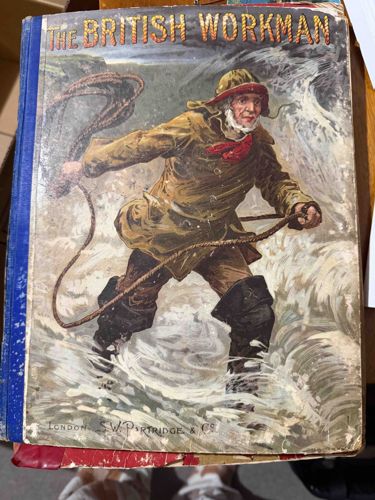
This item is an antique bound volume, likely an annual publication, titled "The British Workman." The cover features a vivid and dynamic illustration depicting a fisherman or sailor in rough seas, battling waves while holding a rope. The central figure is dressed in a tan or olive-green coat, dark trousers, and tall, dark boots, with a red neckerchief and a hat covering his ears and tied under his chin. His face shows a determined expression. The background illustrates a stormy sea with large, breaking waves. The title "THE BRITISH WORKMAN" is prominently displayed at the top in a large, serif font, rendered in orange-brown letters. The publisher's information, "LONDON: S.W. PARTRIDGE & CO.", is visible at the bottom of the cover.
The physical characteristics of the book include a hardcover binding, with a distinct royal blue spine. The top and bottom edges of the spine and cover show significant wear, chipping, and fraying, exposing the underlying board. The front cover itself exhibits considerable surface wear, scuffing, and some discoloration consistent with age and handling. There are discernible scuff marks and a general dullness to the once-vibrant illustration. The red fore-edge of the pages is partially visible, indicating a decorative page edge that has also seen some wear. The overall impression is that of a well-used but structurally intact antique book. Given similar publications by S.W. Partridge & Co., this annual likely dates to the early 20th century, probably around 1915, aligning with the style of illustration and binding popular during that period. The quality of the cover illustration suggests an attempt at engaging the target audience with a heroic and enduring image of a British worker.
AI Appraisal Report
Based on my visual examination of the provided image, I can assess certain aspects of this antique bound volume, likely 'The British Workman Annual' (Vol. LXI, c. 1915). The cover art, depicting a rugged fisherman, is characteristic of the period's attempt to valorize working-class figures. The hardback binding and prominent publisher (S.W. Partridge & Co.) are typical.
Regarding condition, the book shows significant wear. The chipping, fraying, and exposed board on the royal blue spine, along with scuffing, discoloration, and dullness on the front cover, indicate heavy use and ageappropriate degradation. The somewhat visible red fore-edge also appears worn. Structurally, it seems intact, which is a positive, but the aesthetic wear is considerable.
Market conditions for such annuals are generally modest. While 'The British Workman' series is well-documented, individual annuals, especially in this condition, are not particularly rare or in high demand among serious collectors unless they contain content of specific historical or artistic significance (e.g., early works by famous authors or illustrators), which cannot be determined from the cover alone. Comparables typically sell in the $20-60 range depending heavily on content and condition.
The primary factors impacting value here are the fair-to-poor external condition and the general abundance of such annuals. The engaging cover art adds some visual appeal, but it's not enough to significantly elevate the price given the physical state.
My assessment of authenticity is limited to what's visible; it appears to be a genuine publication from the stated era by the noted publisher. However, without a physical inspection, I cannot verify the integrity of the binding, completeness of the interior pages, presence of any foxing or internal damage, or confirm the precise publication year (though c. 1915 is a reasonable estimate based on the Vol. LXI context). A physical examination would allow me to check the title page, assess paper quality, and identify any unique inscriptions or signatures, which could considerably impact the value.