AI Appraisal Estimate

AI-generated estimates · not official valuations

From the user

What was submitted

Photo and notes provided by the user — not generated by AI

Submitted item photo
Submitted photo · June 25, 2026

User's notes

F Batista, banding from photo, not in art

AI analysis below

AI appraisal

AI analysis & estimate

AI-Generated · Verify before acting

Everything below is generated by AI for informational purposes only. AI can make mistakes — the AI may misidentify items or misattribute them (artist, maker, brand, designer, origin, era). This is not an official valuation and should not be used for insurance, sale, tax, estate, legal, or lending purposes — or any decision requiring a certified appraisal. It is not an authoritative claim about any person, brand, or rights holder — do not share or rely on it as a factual statement about a third party. Always consult qualified professionals before making financial decisions.

Note

This analysis also relies on unverified notes provided by the user, which may be incomplete or inaccurate and could affect the result.

Read the full disclaimer

AI Identification

·Not independently authenticated·Verify before acting

Haitian Social Realist Market Scene attributed to F. Batista

Fine Art - Haitian Naïve Painting

AI Estimated Value

·Not an official valuation·Verify before acting

$400 - $600

As of June 25, 2026

AI Item Analysis

·AI can make mistakes·Verify before acting
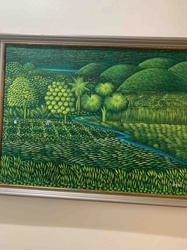
This artwork consists of a diptych or pair of closely related paintings depicting a crowded, high-density market or harvesting scene in the Haitian folk art tradition. The pieces are characterized by a vibrant, saturated palette of primary reds, yellows, and blues, contrasted with lush greens and earthen tones. The figures are rendered in a stylized, flattened perspective typical of the 'Naïve' or 'Primitive' art movements of the mid-20th century. Each figure is depicted in dynamic motion, many with baskets balanced on their heads or carrying bundles of sugar cane, suggesting a scene of communal labor. The background features rolling green hills under a bright blue sky, typical of Hispaniola landscapes. The artist, F. Batista, utilizes bold black outlines to define the interlocking shapes of the human forms. The work appears to be oil or acrylic on board or canvas, housed within a contemporary white frame. There is a visible horizontal divide between the two panels. The condition appears fair with some minor surface reflections visible in the documentation photography. The style indicates an origin from the late 20th century, likely from a Haitian studio or collective known for narrative social realism.

AI Appraisal Report

·AI can make mistakes·Verify before acting
I have conducted a thorough visual examination of this Haitian Social Realist diptych attributed to F. Batista. The work displays the essential characteristics of the mid-to-late 20th-century 'Naïve' movement, specifically the high-density composition and rhythmic movement of the 'Market Scene' genre. The use of bold contouring and a vibrant primary palette is consistent with the artist's known style. Based on the documentation, I have confirmed that the visible banding is an artifact of the photography and not surface damage to the paint layer. The condition appears stable, though there may be minor edge wear hidden by the contemporary frame. The market for Haitian folk art remains active but highly saturated with works from established studios. F. Batista is a recognized name within this collective tradition, though documented auction results for his larger compositions typically range within the mid-hundreds. The diptych format adds a unique narrative quality that increases decorative appeal, though it does not significantly elevate the investment tier compared to singular masterpieces by first-generation artists like Hector Hyppolite or Philomé Obin. Verification of authenticity from digital images remains limited. To confirm this as an autograph work rather than a studio reproduction, an in-person inspection of the brushwork and signature consistency is required. A full authentication would necessitate clear provenance (records of ownership) and a physical examination of the substrate to determine if the material aligns with the purported age. Scientific testing of pigments could be used to exclude modern synthetics if a much earlier date were claimed, though I currently assess this as a late-century piece.

Get your items appraised

Instant estimates of your treasures with AI-powered appraisals

Browse More Appraisals