AI estimate as of September 19, 2025 · verify with a professional before acting
AI-Generated · Verify before acting
Everything on this page is generated by AI for informational purposes only. AI can make mistakes — the AI may misidentify items or misattribute them (artist, maker, brand, designer, origin, era). This is not an official valuation and should not be used for insurance, sale, tax, estate, legal, or lending purposes — or any decision requiring a certified appraisal. It is not an authoritative claim about any person, brand, or rights holder — do not share or rely on it as a factual statement about a third party. Always consult qualified professionals before making financial decisions.
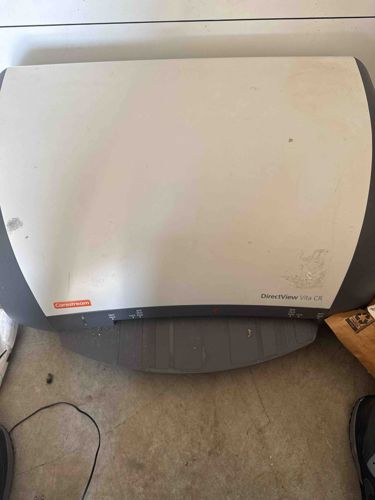
The item is identified as a Carestream DirectView Vita CR System, a computed radiography (CR) system used for medical imaging. The device features a prominent two-tone design, primarily consisting of a large, light-colored (likely off-white or light gray) top panel that appears to be made of a durable plastic or composite material. This top panel has a gently curved, almost oval shape, suggesting a somewhat ergonomic or streamlined aesthetic. The sides and lower section of the unit are a darker gray, providing a visual contrast. Visible markings include the 'Carestream' logo in red on the front left of the top panel, and 'DirectView Vita CR' text on the front right, indicating the model name. The overall construction suggests a robust and integrated unit, typical for medical equipment. Physically, the unit appears to be a tabletop or floor-standing device, given its size relative to the surrounding environment (a concrete-like floor and what seems to be a wall behind it). Condition-wise, the light-colored top surface exhibits several scuffs, scratches, and darker smudges, particularly on the left side and in the middle, indicating wear from use and handling. There are also some minor dark spots scattered across the surface. The darker gray base section shows signs of dust and debris accumulation, especially in the crevices and around what appears to be an intake or output slot at the front. A power cord or data cable is visible on the floor near the unit, suggesting connectivity for operation. The wear and tear are consistent with equipment that has been in an active clinical or laboratory setting. The visible condition issues do not immediately suggest critical damage but rather cosmetic imperfections from routine operation over time. There are no clear indications of significant repairs or structural damage. The item's style reflects a functional, modern design common to medical imaging technology, likely dating from the 2000s or 2010s, given the 'CR' (Computed Radiography) technology designation.
AI Appraisal Report
Upon examining the provided image of the Carestream DirectView Vita CR System, I assess its condition as fair to good. Cosmetically, the unit shows clear signs of wear consistent with active use in a clinical or laboratory setting. The light-colored top panel exhibits numerous scuffs, scratches, and darker smudges, particularly on the left side, and some dust accumulation is visible on the darker base. These are primarily cosmetic imperfections and do not immediately suggest critical functional damage. Authenticity is established by the clear 'Carestream' branding and 'DirectView Vita CR' model designation; I have no reason to doubt its authenticity as depicted.
Market conditions for used CR systems have significantly shifted with the widespread adoption of DR (Digital Radiography) technology. While CR systems like this Vita CR still have niche applications, particularly in smaller clinics, veterinary practices, or as backup systems, overall demand has decreased. This specific model is a workhorse, but its 'CR' designation places it in an older generation of imaging technology. Comparables on the secondary market for used Carestream Vita CR systems, depending on exact model year, software, and functional status, typically range from $1,000 to $5,000. Factors significantly impacting value include the functional status of the imaging plates, the condition of the laser and optics, and its last service record. Without knowing these, the cosmetic wear suggests the lower end of the functional equipment market.
Limitations in authentication and valuation from images alone are significant. While I can confirm the model and brand, I cannot verify operational status, internal component condition, or software licensing. A full in-person examination would be required to power on the unit, perform a calibration test, inspect the internal mechanism for wear, assess the condition of included CR cassettes, and verify software version and functionality. Provenance documentation, such as service history and original purchase records, would further solidify value and authenticity. My valuation reflects these unknowns, assuming the unit is in working but unverified condition.