AI estimate as of August 31, 2025 · verify with a professional before acting
AI-Generated · Verify before acting
Everything on this page is generated by AI for informational purposes only. AI can make mistakes — the AI may misidentify items or misattribute them (artist, maker, brand, designer, origin, era). This is not an official valuation and should not be used for insurance, sale, tax, estate, legal, or lending purposes — or any decision requiring a certified appraisal. It is not an authoritative claim about any person, brand, or rights holder — do not share or rely on it as a factual statement about a third party. Always consult qualified professionals before making financial decisions.
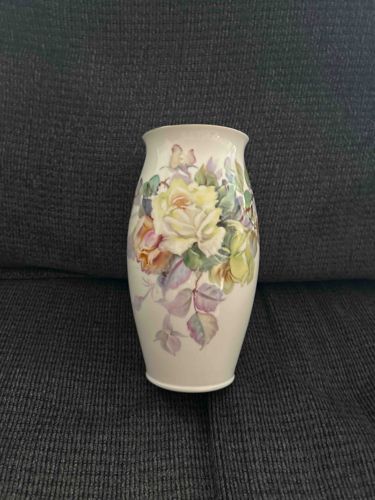
This is a ceramic vase, likely made of porcelain or fine earthenware, distinguished by its elegant floral decoration. The vase has a classic, slightly flared rim and a gently tapering body, resting on a small, recessed foot rim. The primary color of the vase is a creamy off-white or very light beige, providing a subtle background for the hand-painted or transfer-printed floral design. The decoration features an array of blooming roses and their accompanying foliage. Prominent yellow roses take center stage, with delicate pink and possibly peach-toned roses intermingled. The leaves are rendered in various shades of green, with some exhibiting hints of purple and brown, suggesting autumn or aged foliage, adding depth and visual interest. The painting style appears to be soft and naturalistic, with blended colors and subtle shading giving the flowers a life-like quality. The surface of the vase has a smooth, glossy glaze. There are no immediately visible chips, cracks, or significant abrasions from the provided image, suggesting good overall condition. No specific maker's marks or signatures are visible in the image, which would be located on the base. Based on the style of floral painting and the overall form, this vase likely dates from the late 19th to mid-20th century, possibly Edwardian, Art Nouveau, or early Art Deco period, embracing a 'cottagecore' or 'shabby chic' aesthetic relevant to its assumed era. The craftsmanship appears to be of a reasonable quality, with attention paid to the details of the floral arrangement and color palette.
AI Appraisal Report
Upon visual examination of the provided image, this Floral Decorated Ceramic Vase appears to be in good overall condition, showing no immediately visible chips, cracks, or significant abrasions. The glossy glaze and vibrant floral decoration suggest careful handling over time. Authenticity, based solely on this image, points to a decorative ceramic piece, likely from the late 19th to mid-20th century, consistent with the described aesthetic. The hand-painted or transfer-printed floral design, featuring prominent yellow and pink roses with naturalistic foliage, is characteristic of the Edwardian to early Art Deco periods, or what might now be termed 'cottagecore' or 'shabby chic.'
Market conditions for unsigned decorative ceramic vases of this nature are generally moderate. Comparables typically sell in the low to mid-hundreds, particularly without a recognized maker's mark or provenance. Demand exists for charming decorative pieces that fit current interior design trends, but rarity is low given the mass-produced nature of many such items from this era. Factors significantly impacting value include the absence of a visible maker's mark on the base, which would command a higher price if identified as a notable manufacturer or studio. The quality of execution, while good, doesn't suggest exceptional artistic merit that would drive a premium.
It is crucial to note the limitations of authenticity verification from images alone. A definitive authentication would require in-person examination to inspect the base for maker's marks, feel the surface for inconsistencies, and assess the quality of the painting by hand, differentiating between hand-painted and transfer-printed more precisely. Provenance documentation, if available, linking the vase to a specific maker, region, or notable collection, would also significantly enhance its value. Scientific testing, such as material analysis, is not typically warranted for items in this price range but could confirm age if needed.