AI estimate as of September 16, 2025 · verify with a professional before acting
AI-Generated · Verify before acting
Everything on this page is generated by AI for informational purposes only. AI can make mistakes — the AI may misidentify items or misattribute them (artist, maker, brand, designer, origin, era). This is not an official valuation and should not be used for insurance, sale, tax, estate, legal, or lending purposes — or any decision requiring a certified appraisal. It is not an authoritative claim about any person, brand, or rights holder — do not share or rely on it as a factual statement about a third party. Always consult qualified professionals before making financial decisions.
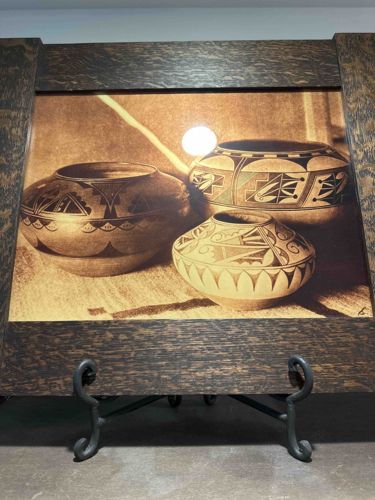
This item is a framed sepia-toned print or photograph, depicting three Native American-style pottery vessels. The print features a warm, monochromatic palette dominated by browns and tans, suggesting an older photographic process or a stylistic choice to evoke antiquity. The three pots are arranged in a still life composition, with two larger pots positioned to the left and rear-right, and a smaller pot in the foreground to the right. All pots are adorned with intricate geometric patterns, indicative of traditional Pueblo or Southwest Native American pottery designs. The craftsmanship of the depicted pottery appears high, with fine detail in the painted motifs. The print itself shows a slight sheen, possibly due to a glossy finish or the glass covering of the frame. There is a prominent circular reflection of a light source visible towards the upper-center of the print, which is a condition issue affecting immediate viewing clarity but reflects the item's current display state. The print is housed within a substantial wooden frame, constructed from what appears to be dark, heavily-grained wood, possibly oak or a similar hardwood, with a visible quarter-sawn or pronounced grain pattern. The frame's style suggests an Arts and Crafts or rustic aesthetic. The item is displayed on a dark, wrought-iron or cast-iron easel with ornate scrollwork feet, indicating it is likely a decorative display piece intended for tabletop or shelf presentation. The easel's dark, matte finish contrasts with the warmer tones of the framed print. No specific maker's marks or signatures are visible on the print or frame, though a faint, dark mark or signature might be present in the lower right corner of the print, obscured by shadow. The overall condition appears good, aside from the light reflection. The estimated age could range from mid-20th century to contemporary, given the stylistic elements.
AI Appraisal Report
Based on my visual examination of the provided image, this framed sepia-toned print of Native American pottery appears to be in good overall condition, aside from a significant light reflection that obstructs a portion of the image. The print itself seems well-preserved behind glass, and the substantial, dark-grained wooden frame suggests a sturdy, possibly Arts and Crafts or rustic aesthetic, further enhanced by its display on an ornate iron easel. The quality of the pottery depicted is high, with intricate geometric patterns, which adds to the visual appeal. However, without any visible artist's signature, edition number, or information regarding the photographer or printmaker, its authenticity as a fine art print by a recognized artist cannot be verified from the image alone. The term 'sepia-toned print' could refer to a modern inkjet print with a sepia effect, or an actual vintage photographic print. This distinction significantly impacts value; a modern decorative print holds far less value than a vintage photographic print by a known artist.
The market for decorative prints of this nature, especially without clear provenance or artist attribution, is generally modest. Comparables would include mass-produced decorative art or framed photographs. The easel adds to the presentation but is considered a separate decorative accessory. Demand for such items is primarily from individuals seeking decorative pieces for home or office, rather than art collectors. The chief factor limiting value is the lack of information regarding the print's origin, age, and artist. Its decorative appeal is its main asset. Factors that would significantly increase its value would be clear identification as a vintage photograph, particularly one by a recognized photographer, or if the depicted pottery itself were exceptionally rare or famous. A physical inspection would be crucial to determine the printing process, paper type, and look for any hidden markings or signatures, which are impossible to ascertain from an image alone.