These notes were written by the person who submitted this item. Appraiser.AI has not verified them, and the AI's identification and estimate may rely on them.
AI Estimated Value
Not an official valuation
$50 - $150
AI estimate as of November 2, 2025 · verify with a professional before acting
AI-Generated · Verify before acting
Everything on this page is generated by AI for informational purposes only. AI can make mistakes — the AI may misidentify items or misattribute them (artist, maker, brand, designer, origin, era). This is not an official valuation and should not be used for insurance, sale, tax, estate, legal, or lending purposes — or any decision requiring a certified appraisal. It is not an authoritative claim about any person, brand, or rights holder — do not share or rely on it as a factual statement about a third party. Always consult qualified professionals before making financial decisions.
This analysis also relies on unverified notes provided by the user, which may be incomplete or inaccurate and could affect the result.
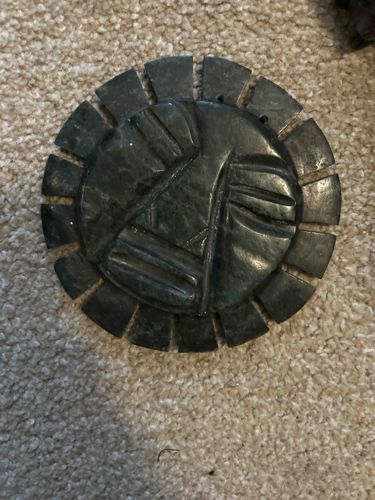
This item is a circular carving, likely made from a deep forest green to almost black stone, exhibiting characteristics consistent with jadeite or a similar serpentine mineral. The stone has a mottled appearance with lighter green veins and darker inclusions, indicative of natural stone rather than a synthetic material. The overall form is a central disk surrounded by radiating rectangular segments, creating a sun-like or calendrical motif. The central disk features carved geometric patterns, including stepped lines, angles, and parallel grooves, which appear to depict a stylized face or abstract motif, possibly referencing ancient Mesoamerican iconography such as the Aztec sun stone or Mayan calendrical symbols. The carving exhibits a relatively smooth, polished surface with some visible tool marks and irregularities, suggesting it was hand-carved. There are two small, drilled holes visible near the top edge of the radiating segments, suggesting it may have been intended for suspension as a pendant or an ornamental hanging. These drill holes are circular and appear cleanly bored. The edges of the radiating segments are somewhat uneven, contributing to the handcrafted aesthetic. The item shows some minor wear consistent with its likely age and material, such as slight surface abrasions and a gentle patina on the raised areas. No significant chips, cracks, or repairs are immediately evident. Based on the material and stylistic elements, it could be a modern folk art piece, a souvenir, or a reproduction inspired by pre-Columbian art, likely dating from the 20th century to contemporary times. The craftsmanship, while not uniformly precise, demonstrates a certain skill in working with the stone to create the intricate relief carving.
AI Appraisal Report
Upon examination of the images provided, I have assessed this circular carved stone disk. The item is fashioned from a dark green, mottled stone, likely a form of serpentinite, often marketed as 'Mexican jade.' The carving style is heavily influenced by Mesoamerican art, specifically recalling the iconography of the Aztec sun stone or Mayan calendrical designs. The craftsmanship suggests a hand-carved piece, likely produced in the latter half of the 20th century to the present day as a decorative or tourist art item. The condition appears to be good, with minor surface wear consistent with its nature and no significant damage like cracks or large chips. Two drill holes suggest it was intended for hanging.
The item's primary value is decorative. Factors significantly impacting this valuation include the material and origin. True jadeite would command a substantially higher price, but the visual characteristics are more consistent with serpentinite, a common and less valuable material. Furthermore, the piece is considered a modern reproduction or folk art piece, not an authentic pre-Columbian artifact. The market for such decorative reproductions is active but generally modest. Comparables would be other similarly sized and detailed Mexican serpentine carvings sold in art or souvenir markets.
It is crucial to note the limitations of this appraisal, as it is based solely on images. Full authentication would require in-person examination to assess the stone's specific gravity, hardness, and refractive index to definitively distinguish between serpentinite and jadeite. Gemological testing could confirm the material composition. Without provenance documentation or archaeological context, it cannot be considered an authentic antiquity.