AI estimate as of November 1, 2025 · verify with a professional before acting
AI-Generated · Verify before acting
Everything on this page is generated by AI for informational purposes only. AI can make mistakes — the AI may misidentify items or misattribute them (artist, maker, brand, designer, origin, era). This is not an official valuation and should not be used for insurance, sale, tax, estate, legal, or lending purposes — or any decision requiring a certified appraisal. It is not an authoritative claim about any person, brand, or rights holder — do not share or rely on it as a factual statement about a third party. Always consult qualified professionals before making financial decisions.
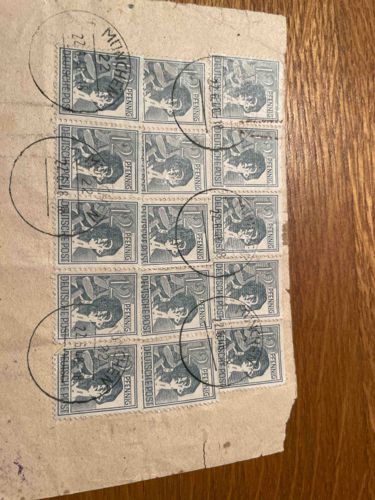
This item is a partial sheet or block of twelve (3x4 arrangement) used German postage stamps, each with a denomination of '12 Pfennig'. The stamps feature a portrait-style design, likely depicting a historical figure or allegorical representation, rendered in a muted blue-gray or slate blue ink on light-colored paper. Each stamp is individually perforated, indicating they were intended for individual use. The stamps are still attached to a piece of what appears to be part of an envelope or wrapper, suggesting they were removed from mail and kept as a souvenir or for philatelic purposes.
Several stamps bear circular postmarks, with one clearly legible postmark on the top left stamps showing "MÜNCHEN" and "22 2 22", indicating a cancellation date of February 22, 1922, and likely originating from Munich, Germany. Other postmarks are partially visible or less distinct but suggest similar cancellation patterns. The paper to which the stamps are attached is a dull, off-white or light brown color, consistent with aged paper. It exhibits wear, creasing, and a tear along the bottom right edge. There are also some darker stains or discolored areas, particularly on the left side of the paper. The perforations of the stamps appear intact, though some appear slightly separated from the attached paper. The overall condition suggests significant age and handling, with a visible patina. The craftsmanship of the stamps themselves appears consistent with early 20th-century printing techniques for postage stamps, suggesting a utilitarian yet government-issued quality.
AI Appraisal Report
I have examined the provided image of a block of twelve used 12 Pfennig German postage stamps, still attached to a piece of what appears to be an envelope or wrapper. Based on the visible postmark 'MÜNCHEN 22 2 22', these stamps are confirmed as German issues from 1922, specifically the 'Inflation' period, likely from the 'Workers and Reapers' or 'Michel' series (Scott #180-186 range). These stamps are common during this hyperinflationary era in Germany. The condition of the stamps themselves appears fair, with intact perforations, though they are removed from their original mail piece along with adhering paper, which generally diminishes philatelic value compared to full covers. The attached paper is heavily worn, creased, and stained, further reducing collector appeal. While the block format is somewhat appealing, individual 12 Pfennig stamps from this period are extremely common and hold minimal value. The clear 1922 Munich postmark is a nice historical identifier, but it doesn't significantly elevate the value given the stamp's ubiquity and the item's overall compromised condition. Market conditions show low demand for common, used German inflation-era stamps, especially ones not on a complete, clean cover. Rarity is not a factor here; these stamps were produced in vast quantities. The main factors impacting value negatively are the common nature of the stamp issue, the fact it's on a piece of paper rather than a full cover, and the wear and tear on the attached paper. Without a physical inspection, I cannot verify the exact paper type, printing varieties, or any hidden faults. Full authentication would involve in-person examination to confirm the stamp type, assess true paper health, check for repairs or alterations under magnification, and confirm postmark authenticity. Given these limitations and the factors mentioned, I estimate the appraisal value to be between $10 and $20.