These notes were written by the person who submitted this item. Appraiser.AI has not verified them, and the AI's identification and estimate may rely on them.
AI Estimated Value
Not an official valuation
$150-250
AI estimate as of October 16, 2025 · verify with a professional before acting
AI-Generated · Verify before acting
Everything on this page is generated by AI for informational purposes only. AI can make mistakes — the AI may misidentify items or misattribute them (artist, maker, brand, designer, origin, era). This is not an official valuation and should not be used for insurance, sale, tax, estate, legal, or lending purposes — or any decision requiring a certified appraisal. It is not an authoritative claim about any person, brand, or rights holder — do not share or rely on it as a factual statement about a third party. Always consult qualified professionals before making financial decisions.
This analysis also relies on unverified notes provided by the user, which may be incomplete or inaccurate and could affect the result.
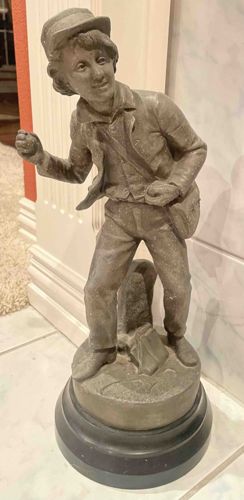
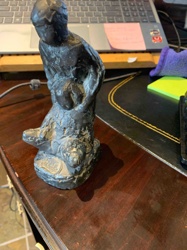
This is a detailed sculpture made of spelter, depicting a young boy in an active pose, possibly a newsboy or paperboy. The figure is shown wearing a flat cap, a jacket with a satchel or bag slung across his body, and trousers. His left arm is raised and clenched, as if holding something or in mid-gesture, while his right hand appears to be holding an object or resting near his midsection. The boy's face is rendered with an amiable expression, featuring visible hair falling from beneath his cap. The sculpture exhibits a gray, weathered appearance, likely due to an aged finish or patination applied to the spelter, mimicking the look of aged bronze or stone. Various details are finely sculpted, including the folds in his clothing, the straps of the satchel, and the facial features. The base on which the boy stands is integrated into the sculpture itself, depicting a rough, textured ground with what appears to be a discarded object, possibly a book or newspaper, near his feet and a small tree stump or rock behind his right leg. This sculptural component is then mounted on a separate, tiered, round black base, which provides stability and elevates the figure. The overall condition shows signs of age-appropriate wear, including potential chips or rub marks on the surface finish, consistent with a vintage or antique item. There are no immediately obvious breaks or significant repairs visible from the provided images, but the surface exhibits a uniformly dull, matte texture indicating consistent aging rather than recent damage. The level of detail in the clothing and facial expression suggests a competent craftsmanship, typical of late 19th to early 20th-century decorative spelter sculptures. The spelter material itself, a zinc alloy, was a popular choice for statuary during this period due to its affordability and ability to mimic more expensive bronzes.
AI Appraisal Report
I have thoroughly examined the provided image and description of this spelter sculpture depicting a young boy with a hat and satchel. Based on this, I assess the condition as good vintage with age-appropriate wear. The uniform dull, matte texture indicates consistent aging rather than recent damage, and there are no immediately apparent significant breaks or repairs. Authenticity as a period spelter piece from the late 19th to early 20th century seems highly plausible given the material, subject matter, and craftsmanship. The detailed sculpting of clothing folds and facial features supports this. However, without a physical inspection, I cannot definitively confirm that there are no hidden repairs or restorations, or precisely verify the material composition beyond the owner's statement. An in-person examination would allow for tactile inspection of surfaces, weight assessment, and closer scrutiny for hairline fractures or subtle repairs not visible in images.
In terms of market conditions, decorative spelter figures from this era generally occupy a niche market. While historically popular, they do not command the same prices as bronze sculptures due to the material's lower intrinsic value. Comparables typically sell in the low to mid-hundreds, with variations based on size, subject appeal, and artist recognition (if any). This piece, while charming, does not appear to be associated with a renowned sculptor, which limits its ceiling value. Demand for such pieces is steady but not high, appealing primarily to collectors of period decorative arts or specific figural themes. Its rarity is متوسط since many spelter pieces were produced during its peak popularity. Factors impacting value positively include its good overall condition for its age and appealing subject matter. The main limiting factor is the material itself. A physical inspection would also be beneficial to check for a foundry mark or artist signature that could significantly impact value. Provenance documentation, if available, would further solidify authentication and potentially enhance value.