AI estimate as of July 19, 2025 · verify with a professional before acting
AI-Generated · Verify before acting
Everything on this page is generated by AI for informational purposes only. AI can make mistakes — the AI may misidentify items or misattribute them (artist, maker, brand, designer, origin, era). This is not an official valuation and should not be used for insurance, sale, tax, estate, legal, or lending purposes — or any decision requiring a certified appraisal. It is not an authoritative claim about any person, brand, or rights holder — do not share or rely on it as a factual statement about a third party. Always consult qualified professionals before making financial decisions.
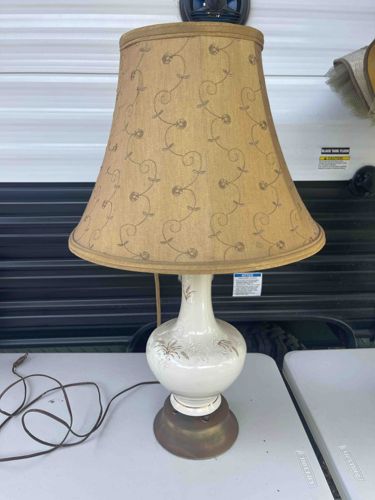
This is a vintage table lamp, likely dating from the mid-20th century, possibly the 1950s or 1960s, given its design aesthetic. The lamp features a flared, bell-shaped lampshade made of a light brown or tan fabric. The shade is adorned with a repeating pattern of delicate, swirling vines and small floral motifs in a darker brown or grey color. The trim around the top and bottom edges of the lampshade appears to be a complementary fabric or piping. The lamp's base is composed of a ceramic or porcelain body resting on a metal stand. The ceramic body is predominantly white or off-white with a glossy finish. It has a distinctive swelling, bulbous shape in the lower portion, tapering upwards to a narrower neck that supports the shade. Subtle decorative elements in a faded gold or brown hue, possibly depicting stylized leaves or abstract designs, are visible on the widest part of the ceramic base. The ceramic section sits atop a darker, possibly bronze or brass-finished metal base that shows signs of age, including some general wear and oxidation, contributing to a rustic patina. The white ceramic portion exhibits some minor scuffs and marks consistent with age and use. The electrical cord, which appears to be a standard two-prong cord, is dark brown or black and shows some coiling and possible age-related stiffness. The overall condition suggests a well-used but structurally intact item, with visible patina on the metal base and some staining or discoloration on the lampshade. There are no readily apparent maker's marks or signatures visible in the provided image, but the craftsmanship appears to be typical of mass-produced decorative lighting from its estimated period.
AI Appraisal Report
Upon examining this vintage ceramic table lamp with a fabric shade, I assess its authenticity as a mid-20th century piece, likely dating from the 1950s or 1960s, based on its design aesthetics and visible construction. The flared fabric shade, with its delicate vine and floral pattern, along with the bulbous white ceramic base on a metal stand, aligns perfectly with the popular styles of that era. The ceramic's glossy finish and the subtle gold/brown decorative elements further support this timeframe.
The condition is consistent with its age and typical use. I observe minor scuffs and marks on the white ceramic, expected wear and oxidation on the metal base contributing to a rustic patina, and some staining/discoloration on the lampshade. The electrical cord appears original, showing coiling and stiffness. While structurally intact, these wear factors suggest it has been well-used, which is common for such vintage household items.
Market conditions for vintage lighting are generally stable, with a steady demand for pieces that can add character to mid-century modern or eclectic interiors. This lamp's appeal lies in its decorative quality rather than its rarity; it appears to be a mass-produced item. Comparable sales for similar vintage ceramic lamps, often found in antique shops or online marketplaces specializing in mid-century decor, typically fall within a modest range, influenced heavily by condition and aesthetic appeal. The lack of apparent maker's marks limits its collectible value to that of a decorative object rather than a piece from a renowned manufacturer.
Factors impacting value include the good, albeit aged, condition and the charming vintage aesthetic. Conversely, the absence of a discernible famous maker, the visible signs of wear, and the likely mass-produced nature prevent it from achieving a higher valuation. For full authentication and to ascertain if any maker's marks are hidden, an in-person examination would be crucial. Furthermore, testing the electrical components for safety would be recommended before use. Without physical inspection, I cannot verify material composition (actual ceramic type, metal alloy) or the condition of internal wiring.