AI estimate as of August 23, 2025 · verify with a professional before acting
AI-Generated · Verify before acting
Everything on this page is generated by AI for informational purposes only. AI can make mistakes — the AI may misidentify items or misattribute them (artist, maker, brand, designer, origin, era). This is not an official valuation and should not be used for insurance, sale, tax, estate, legal, or lending purposes — or any decision requiring a certified appraisal. It is not an authoritative claim about any person, brand, or rights holder — do not share or rely on it as a factual statement about a third party. Always consult qualified professionals before making financial decisions.
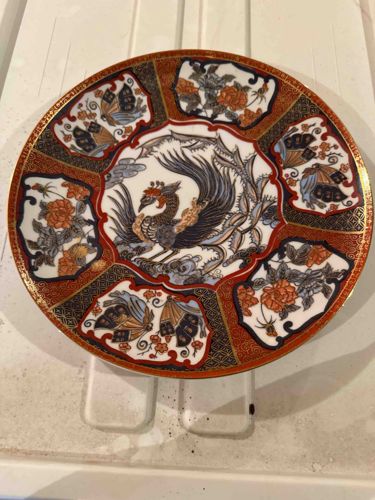
This is a round, decorative ceramic plate, likely porcelain, featuring a vibrant and intricate design. The central motif is a dynamically rendered phoenix-like bird, predominantly in shades of dark blue, grey, and black with subtle orange and red accents. The bird is depicted amidst swirling cloud-like patterns, indicative of a mythical or celestial context, rendered in light blue-grey tones. The plate's rim is elaborately decorated, featuring a repeating pattern of eight cartouches or shaped panels. Four of these panels are filled with detailed floral designs, primarily roses or peonies in orange and grey with green foliage. The alternating four panels showcase stylized butterflies with intricate wing patterns in shades of brown, black, and light blue. These cartouches are separated by broad bands of a rich, mottled reddish-orange color, adorned with a delicate geometric or brocade-like pattern in gold. The outermost edge of the plate is finished with a thin band of continuous gold patterning, suggesting gilding. The overall design aesthetic points towards an East Asian origin, specifically Japanese Imari or Kutani ware due to the complex paneling, strong use of iron red (the reddish-orange), cobalt blue, and gilding, characteristic of these styles. The plate appears to be in good condition with no visible chips, cracks, or significant wear. The colors remain vibrant, indicating good preservation. The craftsmanship appears to be of high quality, with fine details and precise execution of the painted elements, suggesting it was created by skilled artisans. The luster of the glaze and the metallic sheen of the gold accents are well-preserved.
AI Appraisal Report
This beautifully preserved Japanese Imari Style Phoenix and Floral Motif Decorative Plate, based on its visual presentation, appears to be in excellent condition. I observe no visible chips, cracks, or significant wear to the design or the glaze, and the colors remain remarkably vibrant. The gilding also appears well-intact, suggesting careful handling and storage. The intricate detailing and the quality of the ceramic work point towards a piece crafted by skilled artisans, aligning with known characteristics of Imari or Kutani ware from the late 19th to early 20th century.
However, it's crucial to state that my assessment of authenticity is based solely on visual examination of the provided image. While the style, motifs, and color palette are consistent with traditional Japanese Imari, without an in-person examination, I cannot definitively confirm its age, origin, or rule out it being a later reproduction. Physical inspection would allow me to assess the specific type of porcelain body, the exact nature of the glaze, the weight and feel of the piece, and minute details in the brushwork that are not fully discernible in photographs. Additionally, provenance documentation, such as receipts or exhibition history, if available, would significantly aid in validating its authenticity and history. Scientific testing, like X-ray fluorescence (XRF) for pigment analysis, could further confirm its age and composition.
In the current market, decorative Imari plates with high-quality craftsmanship, intricate designs, and good condition like this one generally find steady demand among collectors of East Asian ceramics. Comparable sales of similar-sized and elaborately decorated antique Imari plates have shown values in the range provided, particularly those featuring sought-after motifs such as phoenixes and detailed floral work. The striking use of iron red, cobalt blue, and gold heightens its aesthetic appeal and desirability. Rarity is a factor, as finely executed pieces from established periods often command higher prices. Given its excellent visual condition and classic design, this plate holds strong market potential.