AI estimate as of August 11, 2025 · verify with a professional before acting
AI-Generated · Verify before acting
Everything on this page is generated by AI for informational purposes only. AI can make mistakes — the AI may misidentify items or misattribute them (artist, maker, brand, designer, origin, era). This is not an official valuation and should not be used for insurance, sale, tax, estate, legal, or lending purposes — or any decision requiring a certified appraisal. It is not an authoritative claim about any person, brand, or rights holder — do not share or rely on it as a factual statement about a third party. Always consult qualified professionals before making financial decisions.
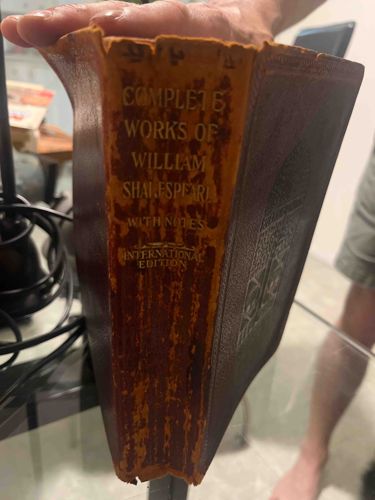
This item is an antique or vintage bound book titled "COMPLETE WORKS OF WILLIAM SHAKESPEARE WITH NOTES INTERNATIONAL EDITION". The book features a rigid, hardcover construction, likely made of leather or a leatherette material, indicated by the worn texture and rich brown hue. The spine, which is prominently displayed, is dark brown with visible gold gilt lettering for the title and edition information. The decorative elements on the spine appear to be embossed or debossed, featuring intricate patterns, possibly geometric or floral, though the detail is somewhat obscured by age and wear. The overall dimensions suggest a substantial volume, likely a folio or quarto size, given its thickness when viewed from the side and the apparent weight as it's held.
The condition of the book shows significant signs of age and use. The edges of the spine and corners of the cover are considerably frayed and chipped, with the underlying board or binding material exposed in places, particularly at the bottom. There is extensive surface abrasion and loss of the original finish on the spine, revealing a lighter, almost orange-brown material underneath, characteristic of aged and distressed leather. This wear suggests the book has been handled frequently and perhaps stored without proper protection. Despite the wear, the integrity of the binding appears mostly intact, as the book is still a singular unit, though its longevity in this state might be questionable. The gold lettering, while faded in areas, is still largely legible, indicating quality craftsmanship at the time of its production. The 'INTERNATIONAL EDITION' designation suggests it might have been part of a wider publishing series or intended for a global market. Given the visible wear and printing style, it likely dates from the late 19th to early 20th century.
AI Appraisal Report
Based on my visual examination of the image provided, this "COMPLETE WORKS OF WILLIAM SHAKESPEARE WITH NOTES INTERNATIONAL EDITION" appears to be a late 19th to early 20th-century bound volume. The rigid, hardcover construction, likely of leather or a similar material, and the gold-gilt lettering on the spine, suggest a quality production for its era. However, the book's condition significantly impacts its value. I observe considerable wear, including fraying and chipping at the cover edges and spine, substantial surface abrasion, and loss of original finish, revealing lighter material beneath. While the gold lettering remains largely legible, indicating its initial quality, the overall distress is evident. The binding appears mostly intact from the visual, but longevity is a concern.
In terms of market conditions, similar worn, mass-produced Shakespeare collected works from this period typically have a modest demand unless they possess unique attributes such as significant provenance, a rare edition, or exceptional binding. The "International Edition" designation does not inherently suggest rarity. Comparables in this condition generally fetch lower prices among collectors, who often prioritize better preserved examples. Demand for common editions in poor condition is low. Without in-person examination, I cannot verify the integrity of the binding internally, assess the condition of the pages (foxing, tears, marginalia), or confirm the exact publication date beyond the general period. Authenticity of the edition itself as a genuine historical print would require inspecting the title page for publisher details, date, and copyright information. A physical inspection would also allow me to gauge the book's feel, smell (for mold or acid deterioration), and internal structure, all of which affect value.