These notes were written by the person who submitted this item. Appraiser.AI has not verified them, and the AI's identification and estimate may rely on them.
AI Estimated Value
Not an official valuation
$40-75
AI estimate as of July 14, 2025 · verify with a professional before acting
AI-Generated · Verify before acting
Everything on this page is generated by AI for informational purposes only. AI can make mistakes — the AI may misidentify items or misattribute them (artist, maker, brand, designer, origin, era). This is not an official valuation and should not be used for insurance, sale, tax, estate, legal, or lending purposes — or any decision requiring a certified appraisal. It is not an authoritative claim about any person, brand, or rights holder — do not share or rely on it as a factual statement about a third party. Always consult qualified professionals before making financial decisions.
This analysis also relies on unverified notes provided by the user, which may be incomplete or inaccurate and could affect the result.
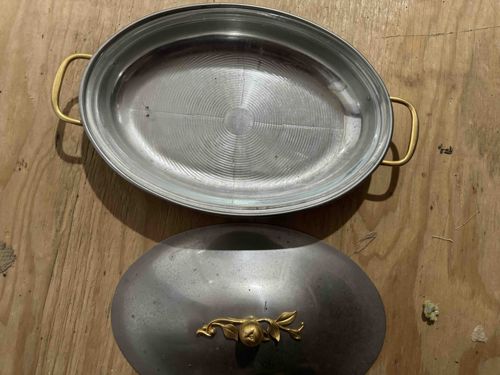
This is an oval-shaped roasting or serving pan, likely made of aluminum, with a matching fitted lid. The main body of the pan has a brushed or satin finish, showing concentric circular marks on the interior base, indicative of a spinning or machining process during manufacturing. It features two brass-toned, D-shaped handles, one on each end, securely attached to the pan's rim. These handles appear to be solid or heavy-gauge, contributing to the item's perceived durability. The lid, also oval, has a slightly domed profile and features an ornate, centrally-placed handle or finial. This finial is a decorative casting, possibly brass or brass-plated, depicting a cluster of small fruits, perhaps berries or grapes, nestled amongst leaves. The overall color palette is silver-gray for the pan and lid, contrasting with the golden hue of the handles and lid finial.
In terms of condition, the pan exhibits signs of heavy use and age. The aluminum surface shows scuffs, scratches, and a dulling of the original finish, consistent with cooking and cleaning over time. There are no obvious dents or major structural damages visible, suggesting it maintains its functional integrity. The brass-toned elements appear to have some patina and perhaps minor discoloration, but their decorative details remain clear. The craftsmanship appears to be utilitarian for the main pan, with the spinning marks suggesting industrial production, while the lid finial shows more detailed casting work, indicating a decorative touch. Given the materials and style, this piece likely dates from the mid-20th century, possibly 1950s-1970s, a period when aluminum cookware was very popular. The decorative finial suggests it was also intended for table service.
AI Appraisal Report
I have examined the provided images and the owner's description of this Oval Aluminum Roasting Pan with Decorative Brass-Tone Lid Handle. The item presents as a utilitarian yet decorative piece of mid-20th-century cookware, likely dating from the 1950s-1970s, consistent with the popular use of aluminum for kitchenware during that period. The construction, with its brushed aluminum finish and spun interior, suggests robust industrial manufacturing, while the decorative brass-toned handles and elaborate fruit-cluster lid finial indicate an intent for both cooking and table presentation.
In terms of condition, the pan shows clear signs of heavy use, including scuffs, scratches, and a dulling of the aluminum surface. This is typical for an item of its age and intended purpose. Despite the cosmetic wear, there are no visible major dents or structural damage, suggesting its functional integrity remains. The brass-toned elements appear to have developed a natural patina, which is generally desirable and indicative of age. Authenticity based solely on images is limited; while the style and apparent construction are consistent with the period described, a physical examination would be necessary to confirm material composition (e.g., solid brass vs. plating on handles/finial) and to thoroughly assess any repairs or alterations. Provenance documentation, such as original purchase receipts or family history, would also strengthen authentication.
Market conditions for vintage aluminum cookware, even with decorative elements, are generally modest. While functional and aesthetically pleasing, it does not typically command high prices unless associated with a particularly renowned manufacturer or designer, which is not evident here. Comparable sales of similar vintage aluminum roasting pans with decorative handles and finials suggest a relatively niche market. The demand is primarily from collectors of vintage kitchenalia or individuals seeking period-appropriate decor. Rarity is not a significant factor here; while this specific design may not be mass-produced today, similar items from the era are relatively common.
Factors significantly impacting value include the utilitarian nature, which means most examples show wear. The lack of a prestigious brand name, and the absence of any unique historical significance limit its investment potential. Its primary value lies in its decorative appeal and functionality as a vintage kitchen item. Its condition, while showing use, does not detract significantly from its value within this modest market segment, as it remains intact and appears functional.
Limitations: Without physical inspection, I cannot confirm the exact composition of the 'brass-tone' elements (solid brass, brass-plated steel, etc.), which could slightly influence value. Nor can I definitively rule out any unseen structural flaws, repairs, or determine its exact manufacturing origin beyond general stylistic cues. An in-person examination would allow for a more precise assessment of surface wear, material integrity, and any potential maker's marks not visible in the images.