AI estimate as of November 18, 2025 · verify with a professional before acting
AI-Generated · Verify before acting
Everything on this page is generated by AI for informational purposes only. AI can make mistakes — the AI may misidentify items or misattribute them (artist, maker, brand, designer, origin, era). This is not an official valuation and should not be used for insurance, sale, tax, estate, legal, or lending purposes — or any decision requiring a certified appraisal. It is not an authoritative claim about any person, brand, or rights holder — do not share or rely on it as a factual statement about a third party. Always consult qualified professionals before making financial decisions.
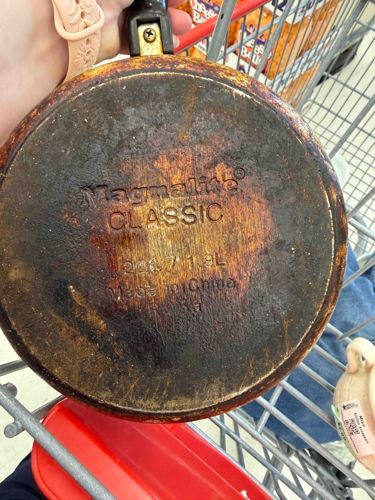
The item is the base of a round piece of cookware, likely a pot or skillet, from the brand 'Magnalite Classic'. The material appears to be a dark, heavy-gauge cast aluminum or similar metallic alloy, characterized by its substantial weight and robust construction. The primary color visible is a heavily discolored, dark brown to black accumulation of residue, likely from prolonged use over high heat, cooking spills, and general grime. Some lighter, almost reddish-brown areas peek through the darker coating, suggesting the original metal color or a different type of burnt-on material. The surface of the base is mostly flat with a slightly raised outer rim. Distinctive impressed markings are present in the center, clearly legible despite the wear and discoloration. These markings include the brand name 'Magnalite®' with the registered trademark symbol, followed by 'CLASSIC' in a larger, bolder font. Below this, there's a reference number '200 / 1.9L', which likely indicates the model number or capacity (1.9 Liters). Further down, 'Made in China' is embossed, specifying the country of manufacture. The piece shows significant signs of heavy use, including extensive carbonized residue and scratching across the entire base. There are no visible cracks or structural damage, suggesting the item, while heavily used and dirty, retains its structural integrity. The handle attachment point is partially visible at the top, showing a small, black handle component secured by a single Phillips head screw into a brass-colored fitting. This type of construction points to a utilitarian, durable design intended for everyday cooking. The style suggests a practical, mid-20th to early 21st-century cookware, designed for functionality rather than ornate aesthetics. The craftsmanship, evident from the cast markings and robust build, points to mass production with a focus on durability.
AI Appraisal Report
Upon visual examination of the Magnalite Classic Cookware base, its authenticity appears to be confirmed by the clearly legible 'Magnalite® CLASSIC' and 'Made in China' embossed markings, consistent with known production items from the brand. The reference number '200 / 1.9L' is specific to this model. However, I must note that my assessment of authenticity is limited to what can be gleamed from the image; a full authentication would ideally require in-person inspection to verify material composition, weight, and subtle manufacturing details for any potential counterfeits, though Magnalite is not a frequent target of such. The condition of this item is poor, characterized by extensive carbonized residue, significant discoloration, and scratching across the entire base. While there are no visible cracks or structural damage, indicating it retains its integrity, the aesthetic wear is severe. In the current market, used Magnalite Classic cookware, especially pieces manufactured in China, typically fetches lower prices compared to older, American-made WagnerWare or Griswold equivalents. Demand for these specific 'Classic' lines is moderate, driven primarily by those seeking functional, durable, budget-friendly cookware rather than collector's items. Rarity is not a factor here; Magnalite Classic was mass-produced. The heavily soiled condition significantly impacts its value, as thorough restoration would be required, which deters many potential buyers. Comparable items in similar condition on secondary markets (e.g., online marketplaces, thrift stores) range from $5 to $20, with cleaner examples commanding slightly more. This particular base, due to its condition, falls on the lower end of that spectrum.