AI Appraisal Estimate

AI-generated estimates · not official valuations

From the user

What was submitted

Photo and notes provided by the user — not generated by AI

Submitted item photo
Submitted photo · June 12, 2026

User's notes

General Electric

AI analysis below

AI appraisal

AI analysis & estimate

AI-Generated · Verify before acting

Everything below is generated by AI for informational purposes only. AI can make mistakes — the AI may misidentify items or misattribute them (artist, maker, brand, designer, origin, era). This is not an official valuation and should not be used for insurance, sale, tax, estate, legal, or lending purposes — or any decision requiring a certified appraisal. It is not an authoritative claim about any person, brand, or rights holder — do not share or rely on it as a factual statement about a third party. Always consult qualified professionals before making financial decisions.

Note

This analysis also relies on unverified notes provided by the user, which may be incomplete or inaccurate and could affect the result.

Read the full disclaimer

AI Identification

·Not independently authenticated·Verify before acting

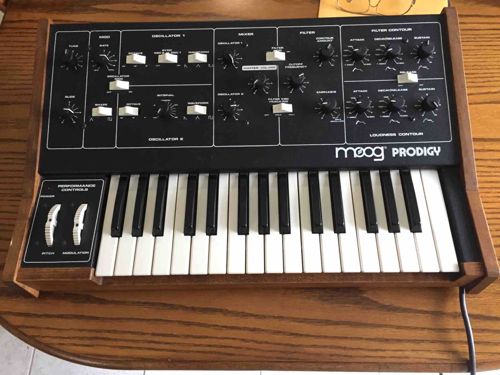
Moog Prodigy Monophonic Analog Synthesizer

Vintage Musical Instruments / Electronic Synthesizers

AI Estimated Value

·Not an official valuation·Verify before acting

$2,200 - $2,800

As of June 12, 2026

AI Item Analysis

·AI can make mistakes·Verify before acting
This is a Moog Prodigy, a classic monophonic analog synthesizer produced between 1979 and 1984. The instrument features a 32-note keyboard (F to C) housed in a chassis with distinctive walnut wood side panels and a black metal control faceplate. The control panel is organized into functional sections including two voltage-controlled oscillators (VCOs), a mixer, Moog's iconic 24dB/octave low-pass filter, and dedicated envelope generators for filter and loudness contours. Physical characteristics include black fluted knobs, white rocker switches, and two white performance wheels for pitch and modulation located to the left of the keyboard. This particular unit appears to be a later production model, as evidenced by the logo styling. The cosmetic condition appears excellent with well-preserved wood grain, crisp white silkscreened labeling, and no immediate signs of significant scuffing or key yellowing. The craftsmanship is typical of the American-made Moog instruments of late 70s and early 80s, prioritizing a compact 'entry-level' design that still utilized professional-grade analog circuitry. While marketed as an affordable option at its release, the Prodigy is now highly sought after for its characteristic 'fat' Moog sound, particularly its bass and lead capabilities.
AI Appraisal Report

·AI can make mistakes·Verify before acting
I have conducted a visual examination of this Moog Prodigy monophonic synthesizer. This unit is a later production revision (c. 1981-1984), identified by the updated logo and branding. The physical condition is exceptional; the walnut end cheeks show no significant dings, and the control surface maintains crisp, unfaded silkscreening. The performance wheels and keybed show no signs of the typical yellowing or 'clacking' associated with heavy use or poor storage environments. Market demand for 'genuine Moog' analog circuitry remains aggressive. While the Prodigy was originally an entry-level model, its dual-oscillator design and signature 24dB ladder filter have made it a favorite for bass and lead sounds, often preferred over modern digital recreations. Recent auction data for 'Near Mint' late-model Prodigies indicates a steady climb in value, particularly for units with well-preserved woodwork. A significant value factor is the 'cleanliness' of the knobs and switches, which suggests this unit was kept in a climate-controlled studio rather than being toured. However, a visual inspection alone cannot verify electronic integrity. To finalize this appraisal, I would require an in-person assessment to check for 'pot scratchiness,' oscillator drift, and the condition of the internal capacitors. Furthermore, I would need to verify if this unit has the S-Trig/Control Voltage inputs on the rear, as documented factory CV mods can increase value by 10-15%. Authentication is based on visual cues; internal serial number matching and a 'gut shot' photo of the PCB would be required for absolute verification of its vintage pedigree.

Get your items appraised

Instant estimates of your treasures with AI-powered appraisals

Browse More Appraisals