Roland Juno-106 Programmable Polyphonic Synthesizer
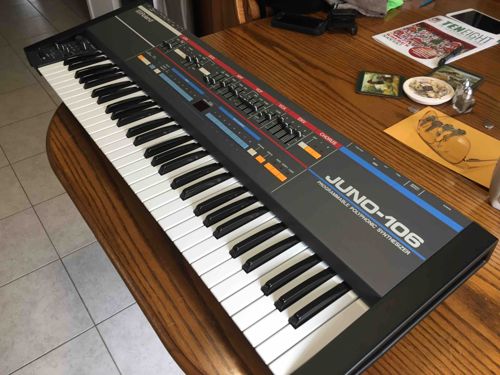
This is a vintage Roland Juno-106, a landmark 61-key analog polyphonic synthesizer first released in 1984. The unit features a sleek, professional aesthetic with an charcoal grey metal chassis, plastic side panels, and a distinctive control panel layout featuring a variety of sliders and buttons in blue, red, and orange accents. Physically, the synthesizer is of significant size, approximately 39 inches wide, and utilizes high-quality tactile faders for hands-on sound manipulation of its digitally controlled oscillators (DCOs) and voltage-controlled filters (VCFs). Notable features include the famous built-in stereo chorus effect, a high-pass filter, and MIDI capability, which was a relatively new industry standard at the time of manufacture. This specific unit shows a remarkably well-preserved condition with minimal visible surface wear across the control fascia. The keys appear aligned and ivory-white without significant yellowing. From an appraisal perspective, the Juno-106 is highly sought after for its iconic '80s sound, though units of this age often require checking for voice chip failure, a common issue with this specific model's integrated circuits. The branding and model name are clearly printed in sharp white and blue typography on the right side of the faceplate. As a piece of musical history, it represents the bridge between pure analog synthesis and the digital control era of the mid-1980s.
AI-Generated Appraisal Disclaimer
Estimated Value
$2,200 - $2,800
Basic Information
Category
Musical Instruments / Vintage Synthesizers
Appraised On
March 9, 2026
Estimated Value
$2,200 - $2,800
Additional Details Provided By Owner
User Provided Information
General Electric
Item Description
This is a vintage Roland Juno-106, a landmark 61-key analog polyphonic synthesizer first released in 1984. The unit features a sleek, professional aesthetic with an charcoal grey metal chassis, plastic side panels, and a distinctive control panel layout featuring a variety of sliders and buttons in blue, red, and orange accents. Physically, the synthesizer is of significant size, approximately 39 inches wide, and utilizes high-quality tactile faders for hands-on sound manipulation of its digitally controlled oscillators (DCOs) and voltage-controlled filters (VCFs). Notable features include the famous built-in stereo chorus effect, a high-pass filter, and MIDI capability, which was a relatively new industry standard at the time of manufacture. This specific unit shows a remarkably well-preserved condition with minimal visible surface wear across the control fascia. The keys appear aligned and ivory-white without significant yellowing. From an appraisal perspective, the Juno-106 is highly sought after for its iconic '80s sound, though units of this age often require checking for voice chip failure, a common issue with this specific model's integrated circuits. The branding and model name are clearly printed in sharp white and blue typography on the right side of the faceplate. As a piece of musical history, it represents the bridge between pure analog synthesis and the digital control era of the mid-1980s.
Get Your Items Appraised
Instant estimates of your treasures with AI-powered instant appraisals