AI estimate as of July 17, 2025 · verify with a professional before acting
AI-Generated · Verify before acting
Everything on this page is generated by AI for informational purposes only. AI can make mistakes — the AI may misidentify items or misattribute them (artist, maker, brand, designer, origin, era). This is not an official valuation and should not be used for insurance, sale, tax, estate, legal, or lending purposes — or any decision requiring a certified appraisal. It is not an authoritative claim about any person, brand, or rights holder — do not share or rely on it as a factual statement about a third party. Always consult qualified professionals before making financial decisions.
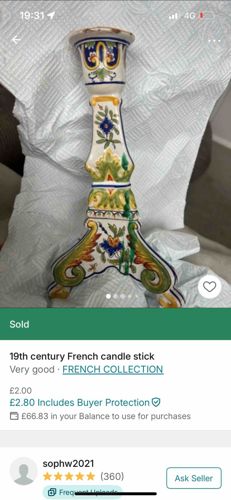
This is a single ceramic or majolica candlestick, with a distinctive hand-painted, colorful design. Its physical characteristics include a fluted, trumpet-shaped top for holding a candle, a tapering central shaft, and a flared, three-legged base. The overall height appears to be approximately 10-12 inches given its context next to a hand and on a domestic surface. The primary color is a cream or off-white background, providing a canvas for the vibrant patterns. The decorative motifs consist of elaborate floral and foliate designs in blues, greens, yellows, and oranges, with notable scrollwork and flourishes, particularly at the flared sections of the shaft and the base. Gold accents are also visible, adding to the ornate aesthetic. The construction suggests it is a molded ceramic piece, likely majolica due to its thick glaze and deep coloration, which often indicates tin-glazed earthenware. There are no readily visible condition issues such as chips, cracks, or significant wear from the image, suggesting it is in 'very good' condition as indicated in the accompanying text. No clear maker's marks or signatures are discernible from the provided images. Based on the seller's description, this item is identified as a '19th century French candle stick,' which aligns with the decorative style and craftsmanship often found in European ceramics of that period, particularly in regions known for faience or majolica production. The quality appears to be good, with a high level of detail in the hand-painting, indicating skilled craftsmanship.
AI Appraisal Report
Upon examining the provided image of this 19th-century French Hand-Painted Ceramic Candlestick, I assess its condition as 'very good'. There are no visible chips, cracks, or significant wear, which is excellent for an item of this age. The vibrant colors and clear detail of the hand-painting suggest well-preserved craftsmanship. Authenticity, based solely on visual cues, appears consistent with 19th-century European majolica or faience production. The decorative style, including the floral motifs, scrollwork, and gold accents, aligns with known French ceramic aesthetics of that period.
Market conditions for antique decorative ceramics are generally stable, with well-preserved, finely decorated pieces commanding respectable prices. Comparable sales for single, finely painted 19th-century French ceramic candlesticks of similar size and quality typically range from $300 to $600. The absence of a pair slightly diminishes the value, as sets are often more desirable, but the individual quality remains high. Demand for high-quality antique decorative arts is consistent, and while not exceedingly rare, a piece in this condition and decorative style is uncommon enough to attract collector interest.
Factors significantly impacting value include its excellent condition, detailed hand-painting, and apparent age. The lack of a clear maker's mark or signature prevents attribution to a specific factory or artist, which would otherwise enhance its value.
My assessment of authenticity is limited by the fact that I am examining an image only. A full authentication would require in-person examination to verify material composition, assess the glaze and paint application under magnification for consistency with period techniques, and detect any potential repairs or restorations. Provenance documentation, such as original sales receipts or family history, would further strengthen the authenticity claim. Scientific testing, if necessary, could confirm the age and composition of the ceramic and pigments.