These notes were written by the person who submitted this item. Appraiser.AI has not verified them, and the AI's identification and estimate may rely on them.
AI Estimated Value
Not an official valuation
$300 - $600
AI estimate as of August 29, 2025 · verify with a professional before acting
AI-Generated · Verify before acting
Everything on this page is generated by AI for informational purposes only. AI can make mistakes — the AI may misidentify items or misattribute them (artist, maker, brand, designer, origin, era). This is not an official valuation and should not be used for insurance, sale, tax, estate, legal, or lending purposes — or any decision requiring a certified appraisal. It is not an authoritative claim about any person, brand, or rights holder — do not share or rely on it as a factual statement about a third party. Always consult qualified professionals before making financial decisions.
This analysis also relies on unverified notes provided by the user, which may be incomplete or inaccurate and could affect the result.
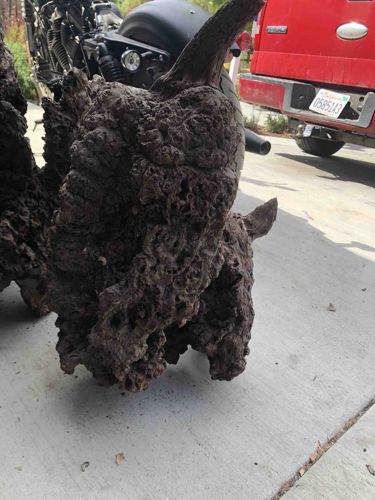
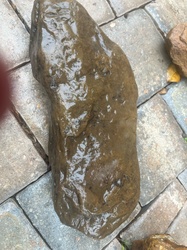
This item is a large, irregularly shaped organic form, strongly appearing to be a large burl or root mass, possibly from a tree. Its physical characteristics are dominated by a deeply textured, highly porous, and convoluted surface, evocative of lava rock or charred wood, though the context suggests wood. The color is a very dark, rich brown, almost black, with hints of reddish-brown, particularly in areas where light catches the surface irregularities. The overall size is substantial, taking up a significant portion of the foreground in the image. Notable features include numerous natural indentations, protuberances, and cavernous openings, suggesting significant natural growth and decay over time. There are no discernible markings, signatures, or obvious signs of manufacturing, indicating it is a natural specimen. Its complex, nubbly surface is consistent with a burl formation, which are woody outgrowths on trees where the grain has grown in a deformed manner. Given the mentioned 'underground burl wood' context, it is likely a subterranean root burl. The condition appears robust, with no visible signs of recent damage or repair. The surface texture implies a dry, perhaps fossilized or heavily weathered state, suggesting considerable age. It possesses a raw, organic aesthetic, typical of reclaimed natural materials often used for decorative purposes, such as unique furniture bases or sculptural garden elements. The craftsmanship, if any, lies in its natural formation and potential extraction and preservation efforts.
AI Appraisal Report
Based on my visual examination of the provided image, this large natural root mass, likely an underground burl from a tree, appears to be in excellent condition. Its deeply textured, convoluted surface and very dark, rich brown coloration are consistent with a well-preserved or weathered natural specimen. There are no apparent signs of recent damage, repairs, or artificial alterations, suggesting its authenticity as a natural formation.
From the image alone, authentication as a specific 'underground burl wood' from 'Nuevo ca' is limited. While its appearance strongly supports it being a natural burl, definitively confirming its origin, species, or exact age would require an in-person examination. A hands-on inspection would allow for tactile assessment, precise measurement, and potentially, wood identification through grain analysis or even dendrochronology if tree rings are visible.
Market conditions for large, unique natural decorative objects like this are generally stable, driven by interior designers and collectors seeking organic, sculptural elements. Comparables include large driftwood pieces, unique root systems, or other natural oddities used as bases for tables, pedestals, or standalone art. Demand exists, but it's a niche market. The rarity is low to moderate; while each burl is unique, similar pieces can be found. Factors impacting value include its substantial size, unique aesthetic appeal, and apparent robustness. Its potential as a base for a custom table or as a garden sculpture adds to its decorative marketability.
To fully authenticate its origin and potentially increase its value, I would recommend: 1) Physical inspection to confirm wood type and assess density/weight; 2) If possible, provenance documentation from the owner regarding its discovery location and circumstances; and 3) For precise age or species identification, material analysis by a wood expert or laboratory, though this would be costly and likely unwarranted given the object's probable value range.