AI estimate as of November 8, 2025 · verify with a professional before acting
AI-Generated · Verify before acting
Everything on this page is generated by AI for informational purposes only. AI can make mistakes — the AI may misidentify items or misattribute them (artist, maker, brand, designer, origin, era). This is not an official valuation and should not be used for insurance, sale, tax, estate, legal, or lending purposes — or any decision requiring a certified appraisal. It is not an authoritative claim about any person, brand, or rights holder — do not share or rely on it as a factual statement about a third party. Always consult qualified professionals before making financial decisions.
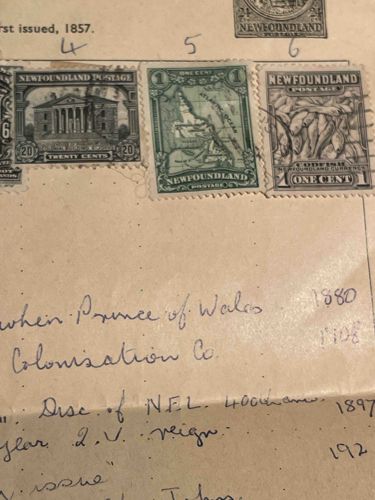
This item is a collection of vintage postage stamps from Newfoundland, affixed to what appears to be a page from a stamp album or an annotated historical document. The visible stamps include three distinct designs. The first stamp on the left is a 20 Cents stamp featuring a detailed black and white engraving of a grand colonial-style building, likely a government edifice in Newfoundland, flanked by '20' and 'TWENTY CENTS' at the bottom, and 'NEWFOUNDLAND POSTAGE' at the top. The second stamp is a 1 Cent green stamp depicting a map of Newfoundland and the surrounding Atlantic Ocean, with 'ONE CENT' at the top corners and 'NEWFOUNDLAND POSTAGE' at the bottom. The third stamp, a 1 Cent stamp, showcases an unusual and striking image of numerous codfish, with 'CODFISH NEWFOUNDLAND CURRENCY' and 'ONE CENT' at the bottom, and 'NEWFOUNDLAND POSTAGE' at the top. All stamps exhibit classic perforations around their edges. Their condition appears to be relatively good for their age, with some minor discoloration and possible light creasing visible on the paper they are attached to, as well as general aging of the paper. There are handwritten annotations on the page beneath the stamps, including phrases like 'when Prince of Wales 1880' and 'Colonisation Co.', along with other dates such as '1897' and '1908', suggesting historical context and possibly the period to which these stamps relate. The 'st issued, 1857' text at the top also indicates the approximate earliest issuance date of stamps in this collection or on this page. The quality of the engravings on the stamps is fine, typical of philatelic artistry of the late 19th and early 20th centuries. These items serve as historical artifacts, showcasing Newfoundland's postal history and unique cultural aspects, such as the significance of codfish to its economy.
AI Appraisal Report
Based on my visual examination of the provided image, this Newfoundland Postage Stamp Collection (1857-1908) appears to be a small, interesting group of three stamps affixed to an album page. The stamps include a 20 Cents building, a 1 Cent map, and a 1 Cent codfish design. Their condition appears to be used, with visible perforations and some expected discoloration and potential creasing on the stamps and backing page, consistent with their age. The handwritten annotations add historical context, though their impact on philatelic value is usually minimal.
In terms of market conditions, Newfoundland stamps are generally collected, but common used examples from this period do not command exceptionally high prices unless they are rare varieties, in pristine condition, or part of a more extensive, specialized collection. The stamps shown here appear to be relatively common issues. Demand exists among British Commonwealth and Newfoundland specialists, but the isolated nature of these three stamps limits their broader appeal.
Factors significantly impacting value include the fact that they are used stamps, affixed to a page, and not presented as mint condition or on cover. The specific varieties (e.g., watermarks, printings) cannot be determined from the image, which can significantly alter value.
My primary limitation in this appraisal is the lack of physical examination. I cannot definitively verify authenticity, gum condition, specific plate varieties, or precisely assess perfs, paper flaws, or repairs from an image alone. An in-person examination by a philatelic expert, potentially with access to specialized catalogs and equipment, would be necessary for full authentication and a more precise grading. Provenance documentation for the collection as a whole would also be beneficial to confirm authenticity and history.