These notes were written by the person who submitted this item. Appraiser.AI has not verified them, and the AI's identification and estimate may rely on them.
AI Estimated Value
Not an official valuation
$30 - $60
AI estimate as of December 15, 2025 · verify with a professional before acting
AI-Generated · Verify before acting
Everything on this page is generated by AI for informational purposes only. AI can make mistakes — the AI may misidentify items or misattribute them (artist, maker, brand, designer, origin, era). This is not an official valuation and should not be used for insurance, sale, tax, estate, legal, or lending purposes — or any decision requiring a certified appraisal. It is not an authoritative claim about any person, brand, or rights holder — do not share or rely on it as a factual statement about a third party. Always consult qualified professionals before making financial decisions.
This analysis also relies on unverified notes provided by the user, which may be incomplete or inaccurate and could affect the result.
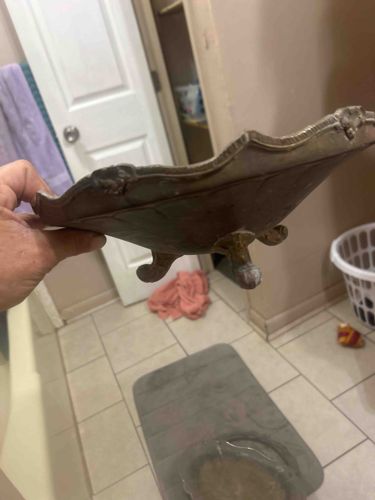
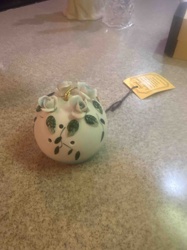
This appears to be a decorative metal dish or trinket tray, likely made in India as per the provided context. The item is characterized by its elongated, somewhat boat-like or leaf-shaped form with a raised, undulating rim. The material appears to be a brass or bronze alloy, exhibiting a tarnished, aged patina with areas of darker discoloration and lighter highlights, suggesting it has not been recently polished. The overall color is a dull, earthy brass or bronze tone. Its construction includes a shallow, rounded basin for holding small items. A notable feature is the ornate, scalloped or scrolled edge along the rim, which adds a decorative touch. The base of the dish is supported by at least two, possibly four, short, scrolled or C-scroll shaped feet, which elevate the piece from the surface. The craftsmanship appears to be cast metal, with some visible irregularities and texture indicative of the casting process. There are no clear maker's marks or signatures visible in the provided images, but the style, with its applied ornamentation and aged appearance, is consistent with decorative wares from India, possibly from the mid-20th century or earlier, though without clearer markings or a view of the underside, a precise age is difficult to determine. The condition shows visible wear and significant patina, which could be considered desirable for an antique or vintage piece, or simply a result of age and lack of cleaning. There are no obvious signs of significant damage like cracks or breaks, though the surface appears somewhat uneven in areas. The quality of casting seems moderate, typical for decorative, mass-produced or semi-handcrafted items from the region.
AI Appraisal Report
Upon examining the provided image of this Indian-made metal decorative dish/trinket tray, I assess its condition as fair to good antique/vintage condition, exhibiting significant age-appropriate patina and some surface irregularities. The tarnished brass or bronze alloy shows a desirable aged character. Authenticity as a period decorative item from India, likely mid-20th century or earlier, appears probable given the style, casting quality, and the 'Made in India' context. I see no obvious signs of significant damage like breaks or repairs.
Market conditions for such decorative Indian metalware are generally modest. Comparable items, often found in antique malls, flea markets, or online marketplaces, typically fall into the 'decorative accent' category rather than 'fine art' or highly collectible antiques. Demand is driven by individuals seeking unique, ethnic, or vintage home decor. Rarity is not a significant factor here; similar items, though varying in specific design, were produced in volume. The primary factors impacting value are the aesthetic appeal of the aged patina, intactness of the scroll feet, and the overall decorative quality.
Without physical inspection, I cannot definitively confirm the precise metal composition, detect subtle repairs, or verify if any perceived imperfections are original to the casting or later damage. A hands-on examination would allow me to better assess structural integrity, the quality of manufacture, and the presence of any hidden marks. Furthermore, provenance documentation would strengthen the historical context. However, based on the visual evidence, the suggested value reflects its standing as a charming, if not highly rare, decorative collectible.