These notes were written by the person who submitted this item. Appraiser.AI has not verified them, and the AI's identification and estimate may rely on them.
AI Estimated Value
Not an official valuation
$250 - $400
AI estimate as of December 15, 2025 · verify with a professional before acting
AI-Generated · Verify before acting
Everything on this page is generated by AI for informational purposes only. AI can make mistakes — the AI may misidentify items or misattribute them (artist, maker, brand, designer, origin, era). This is not an official valuation and should not be used for insurance, sale, tax, estate, legal, or lending purposes — or any decision requiring a certified appraisal. It is not an authoritative claim about any person, brand, or rights holder — do not share or rely on it as a factual statement about a third party. Always consult qualified professionals before making financial decisions.
This analysis also relies on unverified notes provided by the user, which may be incomplete or inaccurate and could affect the result.
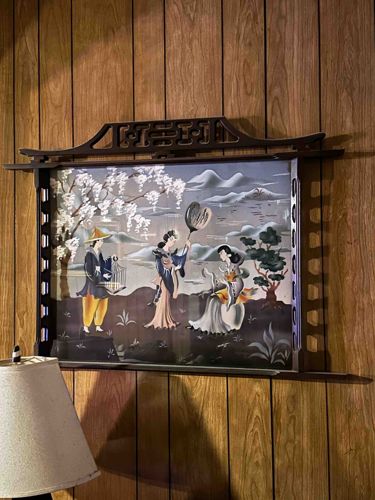
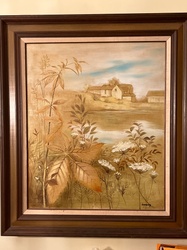
This item is a decorative reverse painted glass panel depicting an oriental garden scene, enclosed within an ornate, dark-stained wooden frame designed in a pagoda or temple architectural style. The painting features three figures, likely two women and one man, dressed in traditional East Asian attire. The man, positioned on the left, wears yellow trousers and a dark jacket, holding what appears to be a birdcage. The two women are centrally located, with one standing and holding a fan, and the other seated or kneeling. The background includes a blossoming white-flowered tree (possibly cherry blossoms), rolling hills or mountains, and smaller trees and foliage. The colors used are generally muted but distinct, with prominent yellow, various shades of grey, blue, pink, and brown. The frame is particularly notable, featuring a prominent roof-like top with intricate openwork carvings, suggestive of traditional Asian architectural motifs. The sides of the frame appear to be solid, possibly wood or a composite material, with a dark, rich finish. The item appears to be in good vintage condition with visible signs of age consistent with the '1950 oriental picture framed' context; however, no significant damage or wear is discernible from the image. The reverse painting technique suggests a certain level of craftsmanship, where details are carefully applied to the back of the glass. The overall aesthetic points to an mid-20th century interpretation of Chinoiserie or an imported piece from an East Asian country.
AI Appraisal Report
I have carefully examined the provided images of this reverse painted glass oriental scene with its pagoda-style frame. The piece presents as a charming decorative art object from the mid-20th century, consistent with the owner's description of '1950 oriental picture framed'.
The condition appears to be very good vintage, with no significant damage visible. The colors of the reverse painting are distinct, and the details of the figures, flora, and landscape are clear. The intricate pagoda-style frame, likely dark-stained wood, is a key aesthetic feature and also appears to be in good order without overt chips or cracks in the carving. The reverse painting technique, while requiring skill, was a moderately common decorative art form during this period, often produced for export.
Market demand for such Chinoiserie-style decorative panels remains steady, particularly for well-preserved examples with appealing frames like this one. Comparables typically range from $150 to $500, with pieces featuring more elaborate frames or higher artistic merit fetching the upper end. This specific item's detailed frame and appealing subject matter place it comfortably in the mid-to-upper range of these comparables.
Factors impacting value include its good condition and the decorative appeal. However, without in-person examination, it's impossible to definitively verify the frame material, the exact painting technique (e.g., if any elements are decals rather than hand-painted), or to check for subtle damage to the glass or paint that might not be visible in photographs. Provenance documentation could potentially elevate value by confirming its origin or artist, should one exist. Scientific testing is typically not applied to items of this decorative value unless there's an extraordinary claim of artistic significance.