AI estimate as of October 24, 2025 · verify with a professional before acting
AI-Generated · Verify before acting
Everything on this page is generated by AI for informational purposes only. AI can make mistakes — the AI may misidentify items or misattribute them (artist, maker, brand, designer, origin, era). This is not an official valuation and should not be used for insurance, sale, tax, estate, legal, or lending purposes — or any decision requiring a certified appraisal. It is not an authoritative claim about any person, brand, or rights holder — do not share or rely on it as a factual statement about a third party. Always consult qualified professionals before making financial decisions.
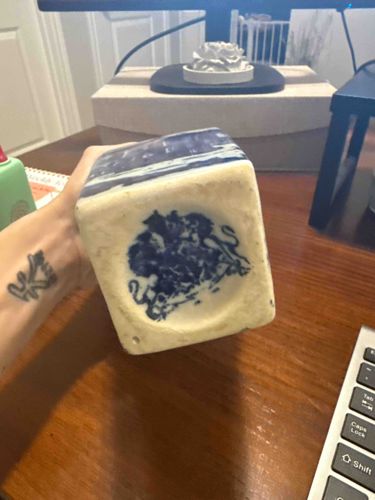
The item appears to be a cubic ceramic object, possibly a planter or a decorative vase, with a distinctive blue and white glazed finish. Its dimensions are not explicitly visible, but it seems to be sized to fit comfortably in one hand, suggesting a moderate size. The primary colors are an off-white or cream base contrasting with a rich, dark cobalt blue. The top and upper sides feature a swirled or marbled blue and white pattern, creating an abstract design. The bottom surface, as visible, is predominantly off-white with an elaborate blue design centrally located. This design appears to be transfer-printed or hand-painted, depicting what might be a heraldic motif or an ornate landscape with a lion-like figure (possibly a ‘Foo dog’ or mythical beast) among floral or cloud-like elements. The overall construction appears sturdy, with distinct corners creating a cube or rectangular prism shape. Notable features include the detailed blue artwork on the base, which stands out against the lighter ceramic body. The surface shows signs of age and wear, including discolored areas and visible dirt or grime, particularly around the recessed area on the base. There are no obvious chips, cracks, or repairs visible in the provided image, but the general patina suggests an older piece. The manufacturing details are not clear; no specific maker's marks or signatures are legible. Based on the aesthetic of the blue and white design, particularly the intricate ornamentation, it could potentially date from the late 19th to mid-20th century, possibly Asian or European in origin, drawing inspiration from classical ceramic traditions. The craftsmanship appears to be of decent quality, indicated by the detailed application of the blue motif and the uniformity of the ceramic form, despite the visible wear. The slightly rounded edges at the bottom suggest it was cast or molded and then glazed.
AI Appraisal Report
Based on my visual examination of the provided image, this blue and white ceramic cube/planter appears to be a decorative item with potential age. The condition, while showing visible signs of dirt, grime, and discoloration consistent with age and use, does not immediately present obvious chips, cracks, or repairs. This suggests a generally sound structural integrity in its current state. The elaborate blue design on the base, possibly a transfer print or hand-painted, depicts a mythical beast amidst floral motifs, hinting at an Asian or European influence, drawing inspiration from classical ceramic traditions. The swirled blue and white pattern on the upper surfaces offers an abstract contrast.
Authenticity from images alone is severely limited; I cannot definitively ascertain the age, manufacturing process (transferware vs. hand-painted detailed), or origin. Without a physical inspection, specific details like glaze consistency, ceramic body quality, and precise artistry remain speculative. Crucially, the absence of visible maker's marks or signatures prevents attribution to a specific factory or artist, which significantly impacts value. Market conditions for similar decorative ceramic cubes or planters, often produced across various periods and regions, are moderate. Demand is generally niche, appealing to collectors of blue and white ceramics or decorative arts. Rarity is difficult to assess without knowing the origin and production volume, but such forms were not uncommon. Factors significantly impacting value include the lack of definitive provenance, origin, and specific age. Furthermore, without an in-person examination, I cannot rule out minor damage hidden by dirt or lighting, nor can I confirm if the detailed base design is a decal versus skilled hand-painting, which carries different value implications.
For full authentication, a physical inspection is necessary to examine glaze texture, ceramic body composition, and potential hidden marks. Scientific testing (e.g., thermoluminescence dating) could determine age. Provenance documentation, such as purchase records or family history, would also be invaluable.