AI estimate as of August 13, 2025 · verify with a professional before acting
AI-Generated · Verify before acting
Everything on this page is generated by AI for informational purposes only. AI can make mistakes — the AI may misidentify items or misattribute them (artist, maker, brand, designer, origin, era). This is not an official valuation and should not be used for insurance, sale, tax, estate, legal, or lending purposes — or any decision requiring a certified appraisal. It is not an authoritative claim about any person, brand, or rights holder — do not share or rely on it as a factual statement about a third party. Always consult qualified professionals before making financial decisions.
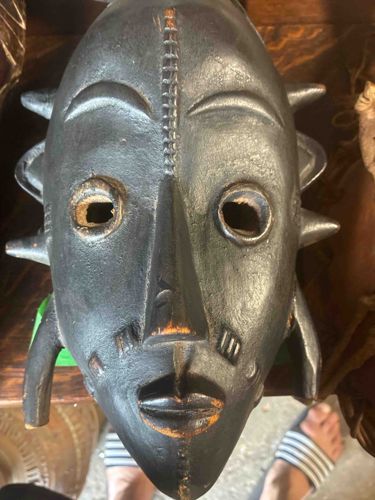
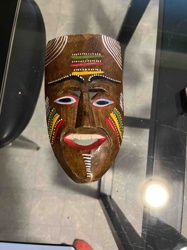
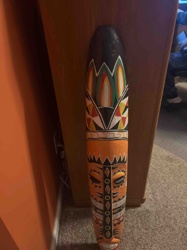
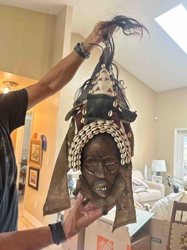
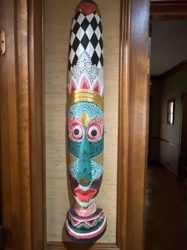
This is a carved wooden mask, likely of African origin, characterized by its dark, almost black, finish. The mask features an elongated oval face with prominent, circular, recessed eye holes that appear to be hollowed out. Above the eyes, the brows are subtly arched and raised. A distinctive vertical ridge runs down the center of the forehead and nose, adorned with carved, repeating geometric patterns resembling a chain or spine. The nose is broad and flattened, leading to full, slightly pouted lips. On either cheek, below the eyes, there are incised geometric markings, possibly scarification patterns or tribal motifs. The sides of the mask present protruding, spike-like elements, adding to its striking appearance. The overall surface exhibits a matte finish, with visible areas of wear, particularly around the eyes, nose, and lips, where the darker pigment has chipped or worn away, revealing lighter, reddish-brown wood underneath. This suggests a degree of age and handling, contributing to its patina. The craftsmanship appears to be hand-carved, with some slight irregularities indicating its artisanal nature. There are no obvious signs of repair, but the wear patterns are consistent with repeated use or display over time. While no maker's marks are visible, the stylistic elements, particularly the facial features and decorative motifs, align with traditional African tribal masks. It presents as a well-made, albeit weathered, piece of cultural significance.
AI Appraisal Report
I have carefully examined the provided image of this carved wooden mask, which appears to be of African tribal origin. The condition is good, exhibiting an authentic patina consistent with age and handling. Visible wear, particularly around the eyes, nose, and lips, where the darker finish has rubbed off to reveal lighter wood, supports a genuine age rather than artificial distressing. The hand-carved irregularities and the dark, almost black, finish with geometric patterns and protruding spikes are characteristic of traditional African masks.
In terms of market conditions, there is a steady demand for authentic tribal art pieces. This mask's distinctive features, such as the prominent geometric patterns, elongated face, and spike-like elements, contribute to its aesthetic appeal and desirability. While not exceedingly rare, a well-preserved and visually striking piece like this holds good collector interest. Factors positively impacting value include its visually arresting design, apparent age, and good overall condition for its type. The tribal motifs and apparent use or display over time suggest cultural significance.
However, it is crucial to state the limitations of this appraisal: full authenticity verification from images alone is impossible. To ascertain its exact origin, specific tribe, and true age, an in-person physical examination is essential. This would allow for tactile inspection of the wood, detailed analysis of carving techniques, and potential identification of specific tribal tool marks. Furthermore, robust provenance documentation (e.g., history of ownership, expert certificates) would significantly enhance its value by confirming its lineage and authenticity. Scientific testing, such as radiocarbon dating of the wood, if feasible and non-invasive, could provide definitive age confirmation.