AI estimate as of August 13, 2025 · verify with a professional before acting
AI-Generated · Verify before acting
Everything on this page is generated by AI for informational purposes only. AI can make mistakes — the AI may misidentify items or misattribute them (artist, maker, brand, designer, origin, era). This is not an official valuation and should not be used for insurance, sale, tax, estate, legal, or lending purposes — or any decision requiring a certified appraisal. It is not an authoritative claim about any person, brand, or rights holder — do not share or rely on it as a factual statement about a third party. Always consult qualified professionals before making financial decisions.
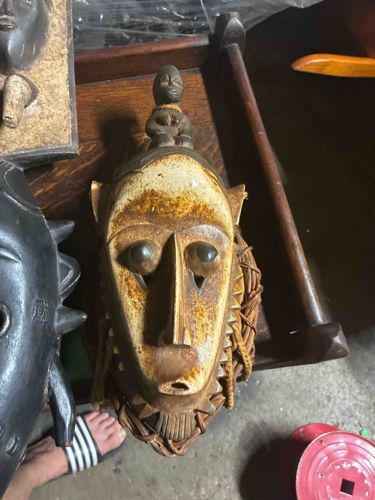
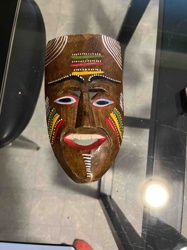
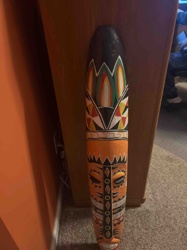
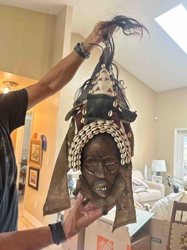
This appears to be an African tribal mask, likely carved from wood, exhibiting a stylized human or ancestral face. The mask features a pronounced forehead that is lighter in color, possibly due to a lighter paint pigment or natural wood grain and wear, contrasted by darker, more reddish-brown tones on the lower face. The eyes are deeply set, appearing as carved ovals with dark pupils or inserts, which adds to a somewhat solemn or mysterious expression. The nose is elongated and prominent, leading down to a small, open mouth. A crucial distinguishing feature is the carved female figure atop the forehead, adorned with a beaded necklace, which could signify fertility, ancestral veneration, or a specific societal role. The mask's perimeter, particularly around the ears and chin, is decorated with woven natural fibers, possibly rattan or raffia, giving it a textural and organic border. Triangular, notched patterns are visible along the sides of the face, adding to its decorative complexity. The surface shows a worn patina, with areas of discoloration and perhaps some light scuffing consistent with age and handling. There are no obvious signs of significant damage like cracks or chips, but the overall appearance suggests an aged artifact. The craftsmanship appears to be a blend of carving and weaving techniques, indicative of traditional African mask-making. It is challenging to determine precise size without a scale, but it appears to be a substantial piece, likely intended for ceremonial use or display. The natural wood and fiber components, along with the detailed carvings, suggest a quality piece of cultural art.
AI Appraisal Report
I have carefully examined the provided image of this African Tribal Mask with Seated Figure Headdress. Visually, the mask appears to be in good, aged condition, showing a consistent patina, wear, and discoloration indicative of traditional materials and age rather than damage. The craftsmanship, evident in the carving and the integrated woven natural fibers, suggests authenticity as a cultural artifact. The stylistic elements, such as the elongated features, deeply set eyes, and the seated figure headdress with beadwork, are consistent with ceremonial masks from various West and Central African traditions.
Without physical examination, I cannot definitively confirm the age or precise cultural origin, nor can I rule out the possibility of it being a well-crafted decorative piece made for the art market, as opposed to a piece used in traditional ceremonies. The market for African tribal art is robust, with strong demand for authentic, well-preserved pieces. Similar masks with intricate carvings and additional elements like headdresses or fiber adornments, especially those with some age, typically fetch higher prices. Comparables indicate that aesthetically pleasing and culturally significant masks, even those without extensive provenance, can command significant value. Rarity is harder to assess without knowing the exact origin, but masks with figures atop the head are less common than standard facial masks, adding to its potential uniqueness.
Factors significantly impacting value include its appealing aesthetics, apparent good condition, and the presence of the distinct seated figure. Limitations to authenticity verification from images alone are considerable. Full authentication would require in-person examination to assess the wood type, carving tools, surface treatment at a microscopic level, and the integration of fibers for traditional construction methods. Provenance documentation, such as collection history or expert opinions from specialists in specific African tribal arts, would be invaluable. Scientific testing, like carbon-14 dating for the wood if feasible, could provide an age range.