These notes were written by the person who submitted this item. Appraiser.AI has not verified them, and the AI's identification and estimate may rely on them.
AI Estimated Value
Not an official valuation
$30-50
AI estimate as of June 21, 2025 · verify with a professional before acting
AI-Generated · Verify before acting
Everything on this page is generated by AI for informational purposes only. AI can make mistakes — the AI may misidentify items or misattribute them (artist, maker, brand, designer, origin, era). This is not an official valuation and should not be used for insurance, sale, tax, estate, legal, or lending purposes — or any decision requiring a certified appraisal. It is not an authoritative claim about any person, brand, or rights holder — do not share or rely on it as a factual statement about a third party. Always consult qualified professionals before making financial decisions.
This analysis also relies on unverified notes provided by the user, which may be incomplete or inaccurate and could affect the result.
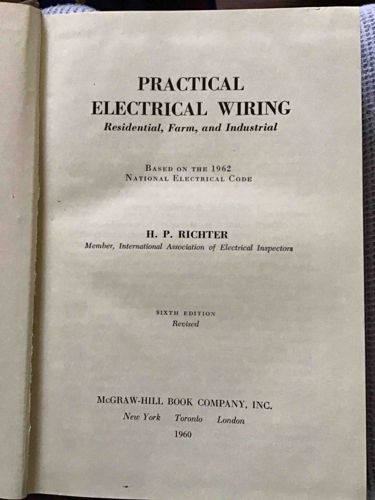
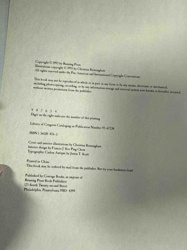
This item is the title page of a book titled "PRACTICAL ELECTRICAL WIRING Residential, Farm, and Industrial". The book is based on the 1962 National Electrical Code and was authored by H. P. Richter, a member of the International Association of Electrical Inspectors. This specific edition is the "SIXTH EDITION Revised". It was published by McGraw-Hill Book Company, Inc. with offices in New York, Toronto, and London, and the publication year is 1960. The page itself is made of cream-colored paper, showing slight discoloration consistent with its age, but no apparent rips, tears, or significant staining. The text is printed clearly in black ink, indicating good legibility. The binding edge of the book is visible on the left, suggesting a sewn or glued binding typical of hardback books from this period. The overall condition appears to be good for an item of its age, with minimal visible wear, reflecting its 'good condition' status. This technical manual would have been used by electricians, farmers, and residential builders in the early 1960s to understand and implement electrical wiring standards.
AI Appraisal Report
I have examined the provided image of "Practical Electrical Wiring, Sixth Edition Revised" by H. P. Richter. Visually, the title page appears to be in good condition, consistent with the owner's description. The cream-colored paper shows slight, age-appropriate discoloration, and the text is clearly legible, indicating good preservation. There are no visible rips, tears, or significant stains, which supports a 'good' condition rating for an item of this vintage. The visible binding edge suggests a typical hardback construction for the period.
Authenticity, based on the image, appears strong. The title, author, edition, publisher (McGraw-Hill), and publication year (1960) are all clearly identifiable and align with published bibliographic records for this specific edition.
Regarding market conditions, technical manuals from the mid-20th century, particularly those tied to historical codes like the 1962 National Electrical Code, have a niche but consistent demand. While not rare, this specific edition's good condition enhances its appeal to collectors of electrical history, apprentices, and electricians interested in historical practices. Comparable sales for similar technical manuals in good condition from this era typically range from $20-$40, depending on the subject matter and author's prominence. Richter's work is well-regarded in its field. The book's utility to understanding historical electrical practices contributes to its enduring, albeit modest, value.
The primary factor impacting value is condition; a 'good' rating for a 60-year-old technical manual is commendable. Demand is driven by historical interest rather than groundbreaking rarity.
It is important to note that my authenticity verification is limited by assessing images alone. A physical in-person examination would allow for tactile verification of paper quality, binding integrity, and the absence of hidden damage or restoration. Confirmation of the complete book content and page count would also require physical inspection. Provenance documentation (e.g., previous ownership records) would further strengthen the authentication process.