AI estimate as of July 18, 2025 · verify with a professional before acting
AI-Generated · Verify before acting
Everything on this page is generated by AI for informational purposes only. AI can make mistakes — the AI may misidentify items or misattribute them (artist, maker, brand, designer, origin, era). This is not an official valuation and should not be used for insurance, sale, tax, estate, legal, or lending purposes — or any decision requiring a certified appraisal. It is not an authoritative claim about any person, brand, or rights holder — do not share or rely on it as a factual statement about a third party. Always consult qualified professionals before making financial decisions.
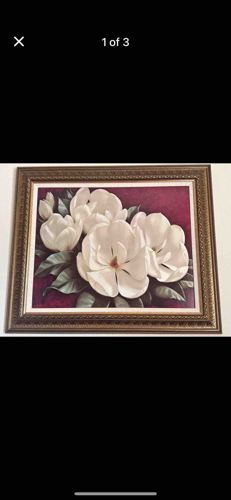
This item is a framed dimensional bas-relief artwork depicting a bouquet of white magnolias on a deep red background. The artwork appears to be a mixed media piece, possibly crafted from sculpted gesso, plaster, or a resin material, giving the magnolia blossoms and leaves a pronounced three-dimensional effect that projects outward from the background. There are at least five magnolias visible: one large, fully open blossom at the center, flanked by two partially open blooms on the right, and two tighter buds to the upper left. The petals of the magnolias are rendered in pure white, with subtle shading suggesting their form and texture, and stamens visible in the center of the largest bloom. The leaves are depicted in various shades of green, showing veining and natural contours, contributing to the realistic appearance. The background is a rich, saturated red, providing a strong contrast that makes the white flowers stand out prominently. The artwork is housed in a substantial, ornate gilded frame. The frame features a classic, possibly Baroque or Rococo-inspired, design with intricate relief patterns, including foliage motifs and architectural elements, finished in a metallic gold or bronze tone. The condition of the artwork itself appears very good, with no visible cracks, chips, or significant discoloration. The frame similarly looks well-maintained, with its gilding intact and no apparent damage. Given the style of the frame and the subject matter, this piece likely dates from the late 20th century, possibly 1970s to 1990s, and represents a popular decorative art style of that period.
AI Appraisal Report
I have examined the provided image of the Framed Dimensional Magnolia Floral Artwork. The condition of this piece appears very good, both for the dimensional artwork itself and its ornate gilded frame. There are no visible chips, cracks, or significant wear on the magnolias or leaves, and the vibrant red background remains strong. The frame's gilding seems intact, without notable damage. Authenticity, based solely on this image, refers to its appearance as a manufactured decorative art piece. As it's a decorative item rather than a fine art painting by a named artist, the concept of 'authenticity' is less about individual authorship and more about its original decorative intent and construction methods. The materials appear consistent with the described bas-relief techniques common in the late 20th century.
Market conditions for decorative bas-relief floral artwork of this type are generally stable but not exceptionally high. These pieces were mass-produced or produced in series, reducing rarity. Comparables often include similar dimensional floral wall art found in home decor stores, antique malls, or online marketplaces. Demand remains consistent among those seeking traditional or transitional decorative elements for their homes. However, the lack of a prominent artist or unique provenance limits its appreciation as an investment piece.
Factors significantly impacting value include its good condition, appealing subject matter (magnolias are perennially popular), and the substantial, well-preserved frame, which adds to its decorative appeal. The dimensional quality itself is a visual draw. Limitations in authentication from images alone mean I cannot confirm the exact material composition (e.g., specific resins, gesso formulas) or the precise manufacturing process. For full authentication and a definitive material analysis, an in-person examination, including tactile inspection to assess weight and surface texture, and potentially scientific testing of materials, would be necessary. Provenance documentation, such as original purchase receipts or artist/manufacturer details, would also be beneficial but are rarely available for such decorative items.