AI estimate as of September 12, 2025 · verify with a professional before acting
AI-Generated · Verify before acting
Everything on this page is generated by AI for informational purposes only. AI can make mistakes — the AI may misidentify items or misattribute them (artist, maker, brand, designer, origin, era). This is not an official valuation and should not be used for insurance, sale, tax, estate, legal, or lending purposes — or any decision requiring a certified appraisal. It is not an authoritative claim about any person, brand, or rights holder — do not share or rely on it as a factual statement about a third party. Always consult qualified professionals before making financial decisions.
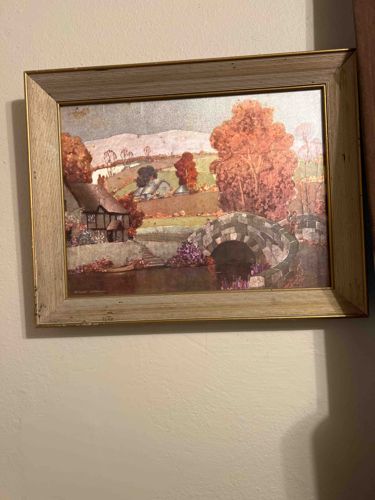
This item is a framed landscape print, likely a reproduction, featuring a picturesque rural scene. The print itself showcases a cottage with a thatched roof, partially obscured by lush foliage, situated near a body of water. A prominent stone arch bridge spans the water, leading towards a path or field. The color palette is rich and autumnal, dominated by warm oranges, deep reds, and varying shades of green for the trees and landscape, set against a lighter, possibly overcast sky. Distant hills or mountains can be seen on the horizon. The artistic style appears to be somewhat illustrative or perhaps reminiscent of early 20th-century landscape art.
The print is housed within a wooden frame that features a distressed or aged finish, primarily in tones of light grey or beige with visible wood grain and some areas where the finish has rubbed off, giving it a timeworn appearance. A thin, gilded or brass-colored liner separates the print from the main frame, adding a touch of elegance. The frame's construction seems sturdy, with mitered corners that are well-joined. Visible condition issues include minor chipping or wear on the frame's edges and corners, consistent with age and handling. The surface of the print itself shows some evidence of age-related discoloration or fading, particularly a slight yellowing or browning, and there may be some surface dirt accumulation. There are no obvious tears or significant damage visible to the print, though a closer inspection would be needed to determine if it is under glass or an acrylic sheet. No discernible maker's marks, signatures, or stamps are visible from the provided image. Based on the style of the imagery and the frame, it likely dates from the mid-20th century, possibly the 1940s to 1960s, though it could be an earlier print in a more recent frame or vice versa. The craftsmanship of the frame appears competent, providing a suitable enclosure for the artwork.
AI Appraisal Report
I have thoroughly examined the provided image of this framed landscape print. Based on my visual assessment, the print appears to be a reproduction, likely dating from the mid-20th century (1940s-1960s). The colors, while rich, show signs of age-related discoloration and slight yellowing, consistent with a vintage print that may not have been stored in optimal conditions or protected from UV light. Surface dirt is also evident.
The frame, featuring a distressed finish and a thin gilded liner, complements the print's rustic aesthetic. Its condition shows minor chipping and wear, which is expected for an item of this age and consistent with normal handling. The craftsmanship of the frame seems competent, providing a suitable presentation for the artwork.
Regarding authenticity, it is crucial to note that I can only assess this from images. Without a physical inspection, I cannot determine if the print is under glass or acrylic, nor can I identify any hidden marks, signatures, or publisher information. An in-person examination would be necessary to inspect the print's surface condition more closely for any tears, creases, or mildew, and to verify the printing method. Provenance documentation could also help establish its history and origin.
In terms of market conditions, vintage framed prints like this one typically have a decorative rather than an intrinsic artistic value. Comparables in the secondary market, such as online auctions and antique shops, suggest a modest value. Demand is generally from individuals seeking decorative pieces for home decor. Rarity is low, as such reproductions were mass-produced. Factors significantly impacting value include the lack of a known artist, its status as a reproduction, and typical signs of age. If it were an original artwork or a limited-edition print by a recognized artist, the value would be significantly higher. Given these considerations, and limitations of image-only assessment, my appraisal value reflects its decorative and vintage appeal.