AI estimate as of December 6, 2025 · verify with a professional before acting
AI-Generated · Verify before acting
Everything on this page is generated by AI for informational purposes only. AI can make mistakes — the AI may misidentify items or misattribute them (artist, maker, brand, designer, origin, era). This is not an official valuation and should not be used for insurance, sale, tax, estate, legal, or lending purposes — or any decision requiring a certified appraisal. It is not an authoritative claim about any person, brand, or rights holder — do not share or rely on it as a factual statement about a third party. Always consult qualified professionals before making financial decisions.
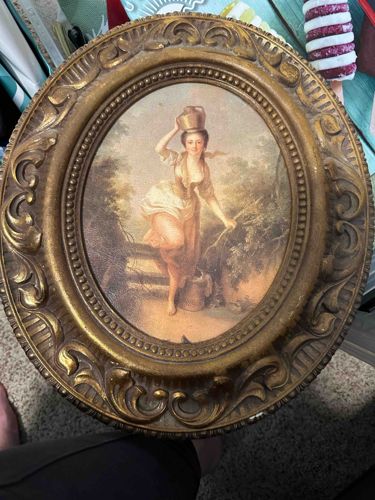
This item is an oval-shaped decorative plaque encased in an ornate, gilded frame. The central image depicts a young peasant girl with a water jug balanced on her head, rendered in a style reminiscent of 18th-century pastoral or Rococo art. She is depicted wearing simple, flowing attire in muted tones of cream and brown, with an expression of gentle determination. The background shows a rustic landscape with trees, foliage, and a wooden fence, suggesting an outdoor, possibly rural, setting. The color palette focuses on earthy tones, creams, and soft greens. The frame itself is highly decorative, featuring a rich, antique gold finish with significant gilding and relief ornamentation. The outermost edge of the frame includes a continuous scrolling or acanthus leaf pattern, while an inner beaded border frames the central image. The craftsmanship of the frame appears to be cast or molded, likely from a composite material such as gessoed wood or resin, which is then gilded to simulate carved wood. Visible condition issues include some wear and loss of gilt, particularly on the raised elements of the frame, revealing a darker underlayer. There may also be slight discoloration or age-related darkening of the central image, though its condition appears generally well-preserved. There are no discernible maker's marks or signatures visible from the provided images, suggesting it might be a mass-produced decorative item or a reproduction of a more famous artwork. Given its style, it likely dates from the late 19th to mid-20th century, drawing inspiration from earlier European art styles. The overall aesthetic suggests it was intended as a decorative wall hanging, adding elegance and a classical touch to an interior.
AI Appraisal Report
Based on my visual examination of the provided image, this Framed Oval Decorative Plaque with Peasant Girl Motif appears to be a decorative wall hanging, likely dating from the late 19th to mid-20th century. The central image, depicting a peasant girl with a water jug, is in a style reminiscent of 18th-century pastoral art. While the image itself seems well-preserved with some age-related darkening, its artistic merit and originality cannot be fully ascertained without closer inspection. The ornate, gilded frame, featuring scrolling and acanthus leaf patterns, shows visible wear and loss of gilt, particularly on raised elements, revealing a darker underlayer. This indicates it is likely cast from a composite material like gessoed wood or resin, rather than hand-carved wood, which suggests mass production rather than unique craftsmanship.
Market conditions for such decorative plaques are generally moderate. While there's a niche market for antique and vintage decorative arts, items that are reproductions or mass-produced, and lack a known artist or significant provenance, typically command lower prices. Comparable items found at antique malls or online marketplaces often fall within a similar price range, reflecting their decorative rather than fine art status. Demand is primarily from individuals seeking period-appropriate decor rather than collectors of significant art. The absence of maker's marks or signatures further limits its value.
Factors impacting value include the visible wear to the frame's gilding. While minor wear can add to an item's antique charm, significant loss of gilt detracts from its overall aesthetic. The primary limitation in authenticity verification from images alone is the inability to physically inspect the materials, construction, and exact medium of the central image. An in-person examination would allow me to determine if the image is a print, painting on board, or other medium, assess the frame's material composition more definitively, and search for unseen marks. Provenance documentation could significantly enhance value if it linked the item to a known manufacturer or artist, or confirmed its age definitively. Without such information, this plaque's value is primarily decorative, placing it in the $50-$150 range.