AI Appraisal Estimate

AI-generated estimates · not official valuations

From the user

What was submitted

Photo and notes provided by the user — not generated by AI

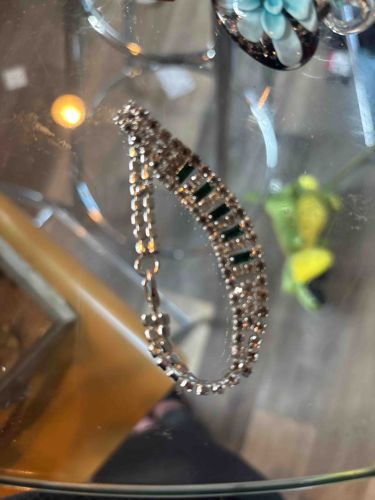
Submitted item photo
Submitted photo · June 6, 2026

User's notes

No additional notes provided.

AI analysis below

AI appraisal

AI analysis & estimate

AI-Generated · Verify before acting

Everything below is generated by AI for informational purposes only. AI can make mistakes — the AI may misidentify items or misattribute them (artist, maker, brand, designer, origin, era). This is not an official valuation and should not be used for insurance, sale, tax, estate, legal, or lending purposes — or any decision requiring a certified appraisal. It is not an authoritative claim about any person, brand, or rights holder — do not share or rely on it as a factual statement about a third party. Always consult qualified professionals before making financial decisions.

Read the full disclaimer

AI Identification

·Not independently authenticated·Verify before acting

Rhinestone and Green Stone Line Bracelet

Jewelry

AI Estimated Value

·Not an official valuation·Verify before acting

$50 - $150

As of June 6, 2026

AI Item Analysis

·AI can make mistakes·Verify before acting
This item is a line bracelet, typically known as a tennis bracelet, featuring a silver-tone metal setting adorned with two rows of clear rhinestones and a central row of rectangular, step-cut green stones. The bracelet appears to be constructed from linked segments, allowing for flexibility. The clear rhinestones are small and round, set closely together to create a continuous sparkle. The green stones, possibly emerald or a simulant like glass or cubic zirconia, are larger and more prominently featured, providing a contrasting color accent. The setting material, although appearing metallic and silver-toned, cannot be definitively identified as sterling silver, white gold, or a base metal alloy without closer inspection for hallmarks. The clasp visible at one end is a lobster claw type, indicating a common and secure fastening mechanism. The condition appears to be good overall, with no immediately visible missing stones or significant tarnishing, though reflections on the surface make a detailed assessment of wear difficult. Given its style, which is characteristic of costume jewelry or more affordable fine jewelry, it likely dates from the mid-20th century onwards. The overall craftsmanship suggests a mass-produced item, though the setting of numerous individual stones indicates a certain level of detail in its manufacture. There are no discernible maker's marks or signatures visible in the provided image.
AI Appraisal Report

·AI can make mistakes·Verify before acting
Based on my visual examination of the provided image, this is a line bracelet, often referred to as a tennis bracelet, featuring clear rhinestones and rectangular green stones. The setting appears to be a silver-tone base metal. The overall condition appears good, with no obvious missing stones or significant damage, though reflections make a definitive assessment of minor wear difficult. This piece strongly presents as costume jewelry rather than fine jewelry. Authenticity of materials cannot be confirmed from an image. The 'rhinestones' are likely glass or crystal simulants, and the 'green stones' are most probably glass, cubic zirconia, or a similar synthetic material, not emeralds, given the style and typical market for such designs. The metal is visually consistent with a plated base metal; without hallmarks or physical testing, I cannot verify precious metal content. Market comparables for similar vintage costume line bracelets range widely but typically fall into the modest double-digit to low triple-digit range. Demand for such pieces is generally steady for decorative wear but not for investment. This item is not particularly rare; mass-produced pieces like this are common. Key factors limiting value are the probable costume nature of the materials (simulated stones, base metal), lack of a designer signature or maker’s mark, and its likely mass-produced origin. The primary limitation to full authentication is the inability to perform in-person tests. To definitively determine material composition (metal purity, stone type) and confirm authenticity, physical inspection, specific gravity tests, refractive index tests, and spectroscopic analysis would be necessary. Without these, the appraisal remains based on visual cues typical of costume jewelry.

Get your items appraised

Instant estimates of your treasures with AI-powered appraisals

Browse More Appraisals