AI estimate as of November 13, 2025 · verify with a professional before acting
AI-Generated · Verify before acting
Everything on this page is generated by AI for informational purposes only. AI can make mistakes — the AI may misidentify items or misattribute them (artist, maker, brand, designer, origin, era). This is not an official valuation and should not be used for insurance, sale, tax, estate, legal, or lending purposes — or any decision requiring a certified appraisal. It is not an authoritative claim about any person, brand, or rights holder — do not share or rely on it as a factual statement about a third party. Always consult qualified professionals before making financial decisions.
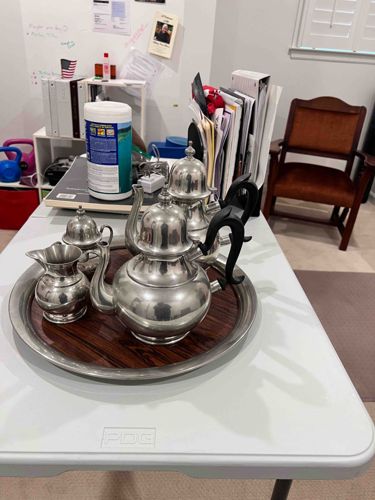
This is a silver-toned tea set, likely made of pewter or silverplate, consisting of at least four pieces: a teapot, a smaller serving pot (possibly a coffee pot or a larger creamer), a sugar bowl with a lid, and a creamer jug. The pieces exhibit a classic, somewhat ornate design, featuring bulbous bodies and domed, finial-topped lids on the larger vessels and sugar bowl. The handles visible on the teapot and the larger serving pot are black, possibly made of ebonized wood or Bakelite, suggesting heat insulation and adding a contrasting element to the metallic finish. The surfaces appear polished, reflecting light, but also show some signs of tarnish or patina, particularly in the crevices and around the base of the handles, which is common for older metallic items. The set is arranged on a round serving tray with a bright, horizontally striped wooden or wood-laminate center, possibly rosewood or a similar exotic wood, framed by a matching silver-toned rim. The condition appears to be good overall, with no overt dents or significant damage visible from this distance, though a closer inspection would be needed to assess minor scratches or wear. The style suggests a mid-20th-century aesthetic, possibly reflecting Art Deco or a more traditional English teaware influence. The craftsmanship appears to be of decent quality, with smooth transitions and well-formed components, though without maker's marks, specific manufacturing details are speculative. The tea set is placed on a white plastic folding table, suggesting it might be stored or used for an informal gathering.
AI Appraisal Report
I have examined the provided image of a silver-toned tea set on a wooden tray. The set appears to consist of a teapot, a coffee/hot water pot, a lidded sugar bowl, and a creamer, presented on a round wooden tray with a silver-toned rim. Based on the visual characteristics, the set is likely silverplate or pewter due to the color and apparent age, showing some areas consistent with tarnish rather than solid silver. The design is classic, featuring bulbous bodies and finial-topped lids. The black handles on the larger pots suggest ebonized wood or Bakelite, typical of mid-20th-century tea sets. The overall condition appears good, with no obvious major dents or damage, though minor scratches or wear cannot be ruled out without a closer physical inspection. The wooden tray seems to be in good condition as well.
Market-wise, similar silver-plated or pewter tea sets from the mid-20th century are relatively common. Unless there are specific maker's marks from a renowned manufacturer or exceptional craftsmanship, demand tends to be moderate. The lack of known provenance or verifiable sterling silver composition limits its value. Comparables for common silver-plated tea sets in good condition, especially those without significant historical or artistic attribution, typically fall within the $75 to $125 range. The accompanying wooden tray adds some aesthetic appeal but does not significantly increase intrinsic value.
A key limitation in this appraisal is the lack of physical inspection. Without examining maker's marks, assessing the silver content (e.g., sterling vs. plate), or checking for subtle damage/repairs, authenticity and precise material composition cannot be definitively confirmed. An in-person examination would be crucial for identifying hallmarks, assessing the true condition of the plating or metal, and identifying any repairs or significant wear not-visible wear that cannot be seen in the image.