AI estimate as of December 4, 2025 · verify with a professional before acting
AI-Generated · Verify before acting
Everything on this page is generated by AI for informational purposes only. AI can make mistakes — the AI may misidentify items or misattribute them (artist, maker, brand, designer, origin, era). This is not an official valuation and should not be used for insurance, sale, tax, estate, legal, or lending purposes — or any decision requiring a certified appraisal. It is not an authoritative claim about any person, brand, or rights holder — do not share or rely on it as a factual statement about a third party. Always consult qualified professionals before making financial decisions.
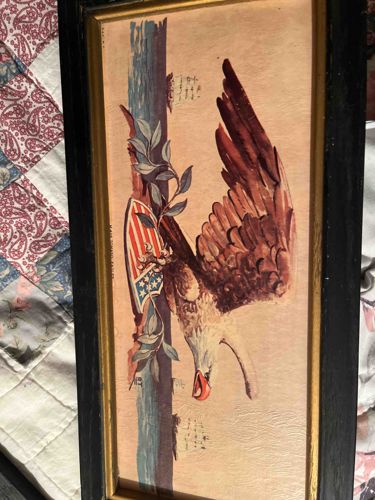
This item is a framed artistic print featuring a patriotic depiction of a bald eagle. The eagle is shown in a dynamic, downward-swooping pose with one wing prominently displayed, showcasing varied shades of brown and reddish-brown feathers. Its head is white, and its beak is open, revealing a reddish interior. The eagle clutches an American flag-inspired shield or escutcheon, which displays red and white stripes and a section with white stars on a blue background. Behind the eagle is what appears to be a vertical element, perhaps a tree trunk or column, colored in shades of blue and brown, adorned with green foliage or olive branches. The background of the print is a muted, light tan or beige color, suggesting aged paper. There appear to be faint, possibly stylized, Asian characters or markings in the background, adding an unusual or decorative element that is not typically associated with American patriotic themes. The print is housed in a simple, rectangular wooden frame with a black finish. A thin, gold-colored fillet or inner border is visible immediately surrounding the print, separating it from the main black frame. The condition appears fair to good for its age, with some visible discoloration or foxing on the print itself, consistent with vintage paper. The frame shows some minor wear or scuffs on its black finish. The artwork evokes a classic American patriotic style but with the intriguing addition of what looks like East Asian script, which could indicate a unique fusion or a specific artist's influence. This piece likely dates from the mid-20th century, given its aesthetic and coloration, possibly from the 1940s to 1960s.
AI Appraisal Report
I've examined this framed patriotic bald eagle print. The artwork, featuring a dynamic eagle with an American shield against a muted background, clearly evokes mid-20th century American patriotism, likely dating from the 1940s to 1960s. The presence of faint, stylized Asian characters in the background is a peculiar and intriguing element, potentially suggesting a unique artist's influence or origin that departs from typical Americana.
Condition-wise, the print appears fair to good for its age. I note visible discoloration or foxing on the paper, consistent with vintage prints, which will slightly reduce value but is expected for an item of this vintage. The simple black wooden frame with a gold fillet shows minor wear and scuffs, typical of an aged piece. The open-mouthed eagle and the specific rendering of the shield are stylistically consistent with the estimated period.
From a market perspective, framed patriotic prints are generally a niche market. While the American eagle is a ubiquitous symbol, the artistic quality, specific presentation, and the unusual inclusion of East Asian script would position this as a decorative piece rather than a fine art collectible. Comparables for such decorative vintage prints typically fall within the $50-$150 range. Rarity is difficult to ascertain without knowing the print’s origin or artist, but similar non-original decorative prints are not exceedingly rare.
Demand is moderate for decorative patriotic items, but not high enough to command premium prices unless significant historical provenance or a known artist is attached. The condition issues, while minor, also impact the upper end of the valuation.
Given that I am appraising this solely from an image, I cannot definitively confirm print authenticity (e.g., if it is truly a print or a hand-colored piece, though it appears to be a print) nor fully assess the nuances of the paper and frame condition. An in-person examination would be necessary to verify the print medium, assess the extent of the foxing firsthand, and determine if the Asian script is original to the print or a later addition. Provenance documentation, if available, would provide invaluable context regarding the artist and origin, which could significantly impact authenticity and value.