AI estimate as of October 21, 2025 · verify with a professional before acting
AI-Generated · Verify before acting
Everything on this page is generated by AI for informational purposes only. AI can make mistakes — the AI may misidentify items or misattribute them (artist, maker, brand, designer, origin, era). This is not an official valuation and should not be used for insurance, sale, tax, estate, legal, or lending purposes — or any decision requiring a certified appraisal. It is not an authoritative claim about any person, brand, or rights holder — do not share or rely on it as a factual statement about a third party. Always consult qualified professionals before making financial decisions.
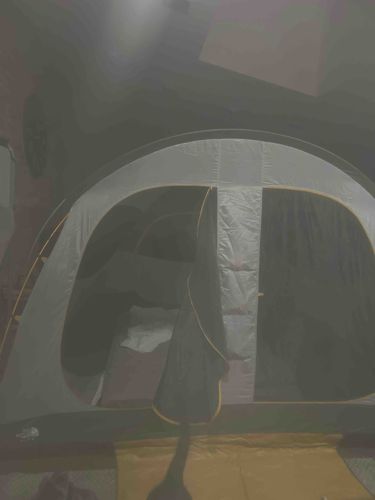
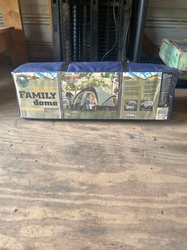
The item is identified as a dome-style camping tent, primarily constructed from a lightweight, fabric-like material, likely nylon or polyester, given its typical use. The tent exhibits a color scheme dominated by light gray panels for the main body, complemented by darker gray or black sections, possibly for enhanced durability or UV protection on the fly. Bright yellow or orange trim is visible along the edges of the tent's openings and structural seams, providing a distinct accent and possibly improving visibility. The tent features a classic dome shape, supported by flexible poles, which are faintly discernible as curved lines. The entrance appears to be a dual-layer zippered opening, likely with an inner mesh panel for ventilation and insect protection, and an outer solid fabric panel for privacy and weatherproofing. There are no clear manufacturer's marks or logos visible in the provided image. The overall condition appears to be relatively good, with no obvious tears, significant stains, or major damage, though the image's low resolution and dim lighting make a precise assessment challenging. The tent seems to be set up indoors, possibly for storage or a trial pitch, resting on a yellow ground tarp or floor. The craftsmanship appears to be standard for a recreational camping tent, with stitched seams and reinforced edges indicative of functional design.
AI Appraisal Report
I have examined the provided image of this dome-style camping tent. Visually, the tent appears to be in relatively good condition, exhibiting no obvious rips, significant wear, or major stains, which suggests careful use or good storage. The construction—lightweight fabric, likely nylon or polyester, with typical dome architecture supported by flexible poles—is standard for recreational camping tents. The dual-layer zippered entrance with presumed mesh for ventilation and solid fabric for weatherproofing is also a common and functional design. The bright yellow/orange trim adds a distinct visual element and potentially enhances visibility.
Based on current market conditions for used recreational dome tents of this apparent size and general condition, and without a specific brand or model identified, comparable items typically range from low-end off-brand models to entry-level branded options. Brands like Coleman, Ozark Trail, or generic sports store models often fall into this category. There is no inherent rarity; such tents are widely available. Demand is generally consistent for functional camping equipment, especially in good condition.
Factors impacting value include the lack of visible branding, which prevents assessing manufacturer reputation or specific model features that might command a higher price. The low resolution and dim lighting of the image make a definitive assessment of minor wear, seam integrity, or fabric degradation challenging. I cannot verify the waterproof ratings, pole material quality, or the functionality of zippers and toggles from the image alone. Without a physical inspection to check for mildew, sticky zippers, stretched elastic in the poles, or pinhole leaks in the rainfly, the estimated value is based solely on outward appearance and assumed functional integrity. An in-person examination would be critical to confirm the absence of these common issues and to verify actual material quality and precise dimensions. Provenance documentation, such as original purchase receipts or user manuals, would be necessary for any specific authenticity claims relating to a particular brand, but as no brand is apparent, this is less relevant here. Given these limitations, the estimated value for a functional, used tent in seemingly good condition, without brand recognition, is in the $70-120 range.