AI estimate as of November 4, 2025 · verify with a professional before acting
AI-Generated · Verify before acting
Everything on this page is generated by AI for informational purposes only. AI can make mistakes — the AI may misidentify items or misattribute them (artist, maker, brand, designer, origin, era). This is not an official valuation and should not be used for insurance, sale, tax, estate, legal, or lending purposes — or any decision requiring a certified appraisal. It is not an authoritative claim about any person, brand, or rights holder — do not share or rely on it as a factual statement about a third party. Always consult qualified professionals before making financial decisions.
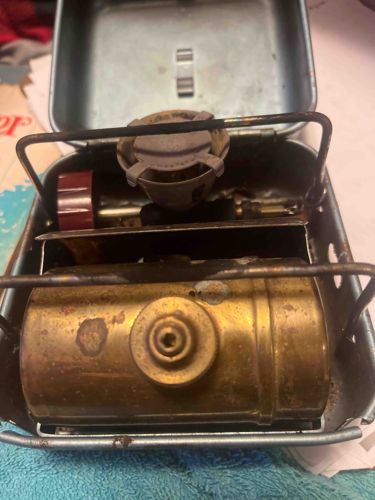
This item is a vintage portable camping stove, likely manufactured in the mid-20th century. It features a compact design, housed within what appears to be a metallic carrying case, which, when opened, forms the stove's operational structure. The primary fuel tank is constructed from brass or a brass-plated metal, exhibiting a rich, aged golden hue with visible signs of oxidation, tarnishing, and some darker spots and streaks, indicative of age and use. A screw-on cap, possibly for fuel filling or pressure release, is identifiable on the brass tank, featuring a concentric ring design with a central Philips head screw indentation. The burner assembly, located above the fuel tank, is made of a gray or silver-toned metal, possibly steel or aluminum, with a cylindrical shape topped by a burner head with multiple perforations for flame dispersal. A dark red or maroon plastic knob, likely for fuel flow control, is situated near the burner. The entire assembly is supported by a robust metal frame, possibly steel or iron, with a dark, almost black, oxidized finish. This frame also supports a grill-like structure over the burner, designed to hold cookware. The outer case, which doubles as the stove's base and wind guard, appears to be made of painted sheet metal, possibly a muted green or gray, and shows considerable scuffing, scratches, and wear, consistent with outdoor use and handling over many years. There are no clear manufacturer's marks or specific model numbers visible in the provided image. The craftsmanship appears utilitarian and robust, built for durability rather than decorative appeal, which is characteristic of camping equipment from its estimated era. The overall condition suggests a well-used but potentially still functional antique or collectible piece.
AI Appraisal Report
I've examined the provided image of this vintage portable camping stove. Based on its design characteristics, material choices—particularly the brass fuel tank and robust metal frame—and utilitarian construction, I estimate its manufacturing period to be mid-20th century, likely between the 1940s and 1960s. The stove is consistent with typical camping equipment of that era, emphasizing durability over intricate aesthetics.
Condition-wise, the stove presents as well-used but structurally intact. The brass tank shows significant oxidation and tarnishing, which is expected with age and exposure, contributing to its vintage appeal rather than detracting significantly from value. The painted outer case exhibits considerable scuffing and scratches, indicative of years of outdoor use. The dark red/maroon knob appears original. Functionality cannot be assessed from an image, but the overall robustness suggests it could be operational with maintenance. I note the absence of visible manufacturer's marks or model numbers, which significantly limits specific authentication and identification of origin.
In terms of market conditions, vintage camping stoves from lesser-known manufacturers typically attract collectors interested in functional antiques or display pieces. Demand is moderate, driven by niche collectors of outdoor gear, vintage enthusiasts, or those seeking camp aesthetics. Rarity without definitive branding is hard to ascertain, but comparable, unbranded stoves generally fall into a specific price tier. Factors impacting value negatively include the lack of clear branding and the significant cosmetic wear. Positively, its completeness and apparent originality are beneficial.
For full authentication and a more precise valuation, an in-person examination is crucial. I would need to assess the integrity of all seals, check for fuel leaks, and attempt a test firing to verify functionality and safety. Identifying any hidden manufacturer marks and examining the metallurgy more closely would also aid in pinpointing its origin and potentially increasing its value. Without this, I can only provide an estimate based on its visual characteristics and what I know of the broader vintage camping equipment market.