AI estimate as of November 8, 2025 · verify with a professional before acting
AI-Generated · Verify before acting
Everything on this page is generated by AI for informational purposes only. AI can make mistakes — the AI may misidentify items or misattribute them (artist, maker, brand, designer, origin, era). This is not an official valuation and should not be used for insurance, sale, tax, estate, legal, or lending purposes — or any decision requiring a certified appraisal. It is not an authoritative claim about any person, brand, or rights holder — do not share or rely on it as a factual statement about a third party. Always consult qualified professionals before making financial decisions.
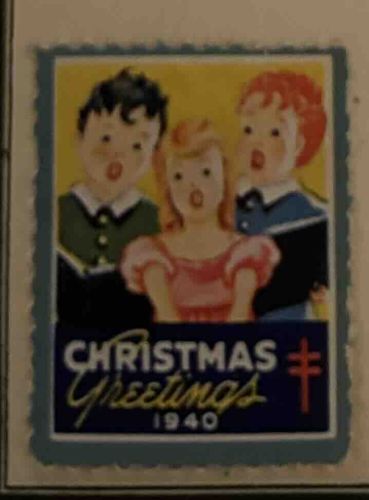
This item appears to be either a Christmas card or a small piece of artwork, likely a print, dating from 1940. The central image depicts three children, two boys and one girl, seemingly singing. The boy on the left has dark hair and is wearing a green shirt with a white collar, holding what looks like a hymn book. The girl in the center has light blonde or reddish-blonde hair and is wearing a pink dress. The boy on the right has red hair and is dressed in a blue shirt with a dark jacket and white collar. All three children have their mouths open as if in song. The background behind the children is yellow. Below the illustration, there is a dark blue banner with the text "CHRISTMAS Greetings" in white capital letters, with "Greetings" written in a script font. Below this, the year "1940" is clearly printed. To the right of the text, a red cross symbol, often associated with Christmas seals or charitable organizations, is visible. The entire design is framed by a light blue border with scalloped edges, giving it the appearance of a postage stamp or a decorative sticker. The overall condition appears to be relatively good for its age, though the image quality makes it difficult to discern subtle wear or discoloration. The colors still seem vibrant. This piece is a charming example of holiday ephemera from the early 1940s, reflecting the artistic style and cultural context of that period. Its construction likely involves printed paper or cardstock.
AI Appraisal Report
I have visually examined the provided image of what appears to be a 'Christmas Greetings 1940' card or artwork. Based on this visual inspection, the item presents in relatively good condition for its age, with colors appearing vibrant and no overt signs of significant damage or discoloration. The illustration style and typography are consistent with early 1940s holiday ephemera, suggesting authenticity. The presence of the red cross symbol is also indicative of charitable Christmas seals common during that era. However, without a physical examination, I cannot conclusively verify the paper type, printing method, or the absence of subtle flaws like minor creases, foxing, or edge wear, which could affect condition slightly.
In terms of market conditions, vintage Christmas cards and seals from this period are generally considered collectible. Demand is steady for well-preserved examples, particularly those with charming illustrations or unique historical significance. This particular piece, while appealing, doesn't immediately stand out as exceptionally rare. Comparables for similar single Christmas cards or seals from the 1940s typically range from $5 to $50, depending heavily on condition, artist, and specific design rarity. The '1940' dating makes it historically interesting but not uniquely rare in the broader ephemera market.
Key factors impacting value include its good apparent condition and period charm. However, it's a mass-produced item, limiting its top-tier value potential. For full authentication and a more precise value assessment, an in-person examination is crucial to assess the true condition, printing techniques, and specific paper characteristics. Verifying provenance, though unlikely for such an item, could also add minor value. Scientific testing is generally not cost-effective or necessary for this type of ephemera.