AI estimate as of November 6, 2025 · verify with a professional before acting
AI-Generated · Verify before acting
Everything on this page is generated by AI for informational purposes only. AI can make mistakes — the AI may misidentify items or misattribute them (artist, maker, brand, designer, origin, era). This is not an official valuation and should not be used for insurance, sale, tax, estate, legal, or lending purposes — or any decision requiring a certified appraisal. It is not an authoritative claim about any person, brand, or rights holder — do not share or rely on it as a factual statement about a third party. Always consult qualified professionals before making financial decisions.
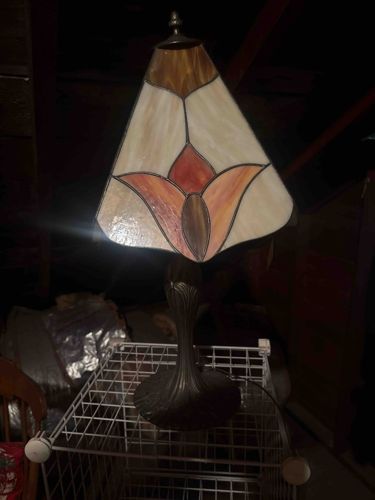
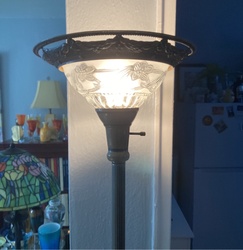
This item is an Art Nouveau style table lamp featuring a stained glass shade and an intricately cast metal base. The shade is constructed from multiple pieces of art glass, soldered together with dark leading lines, creating a geometric and stylized floral motif. The primary colors in the shade include a cream or off-white opaque glass forming the larger sections, complemented by amber, various shades of orange (from pale to reddish-orange), and brown glass pieces that shape the central floral design. The top portion of the shade incorporates additional amber-colored glass panels. The shade is conical or pyramidal in shape, tapering upwards to a finial-like element that connects it to the lamp's structure. The base appears to be made of a dark-colored metal, possibly bronze or a bronze-finished pot metal, exhibiting a relief-molded, organic, and flowing design with fluted or foliate elements resembling upward-reaching tendrils or petals. The base is broad and stable, providing support for the lamp. The lamp appears to be electric, with a visible electrical cord and an inline switch or pull chain mechanism (parts of which are visible on the right side of the image). Visible condition issues include what appears to be dust and general grime from storage, and a potential slight bend or misalignment in the shade's structure on the lower left side, though this could be an optical illusion or minor wear. The craftsmanship suggests a commercially produced lamp from the late 20th century, likely mimicking earlier Art Nouveau designs. The use of varied glass textures and colors indicates a moderate quality piece, designed to evoke a classic aesthetic.
AI Appraisal Report
Based on my visual examination of the provided image, this Art Nouveau style stained glass table lamp presents as a decorative piece from the late 20th century, likely produced within the last 30-50 years, rather than an authentic antique. The construction quality, while decent, suggests commercial manufacturing mimicking earlier designs. The geometric and stylized floral motif of the shade, with its cream, amber, orange, and brown glass, is aesthetically pleasing and characteristic of the Art Nouveau influence. The dark leading lines appear consistent across the shade.
Condition-wise, the lamp appears to have general dust and grime, suggesting it has been stored or displayed for some time without cleaning. I note a potential slight misalignment or bend in the lower left portion of the shade, which could be minor wear or an optical illusion from the angle of the photograph. The cast metal base with its organic, flowing design is a common feature in reproduction Art Nouveau lamps and appears solid. The electrical components, including the cord and visible switch, further support a more modern origin in terms of electrical safety standards.
Market conditions for such reproduction Art Nouveau stained glass lamps are generally steady but not exceptional. They are appreciated for their decorative appeal but do not command the high values of genuine Tiffany or period Art Nouveau originals. Comparables typically sell in the low to mid-hundreds, depending on size, condition, and specific design appeal. Rarity is low as similar items were mass-produced.
Factors impacting value include its decorative appeal, the overall condition, and the perceived quality of the glass and metalwork. The lack of documented provenance significantly limits its value, especially for an item that could easily be misrepresented. To fully authenticate its age and manufacturer, one would need to conduct an in-person examination to inspect the soldering technique, glass types (specifically looking for tell-tale signs of antique vs. modern art glass), internal wiring, socket type, and any manufacturer's marks on the base or shade. Scientific testing of the metal composition could also confirm its age. Without these, I must appraise it as a well-made vintage reproduction.